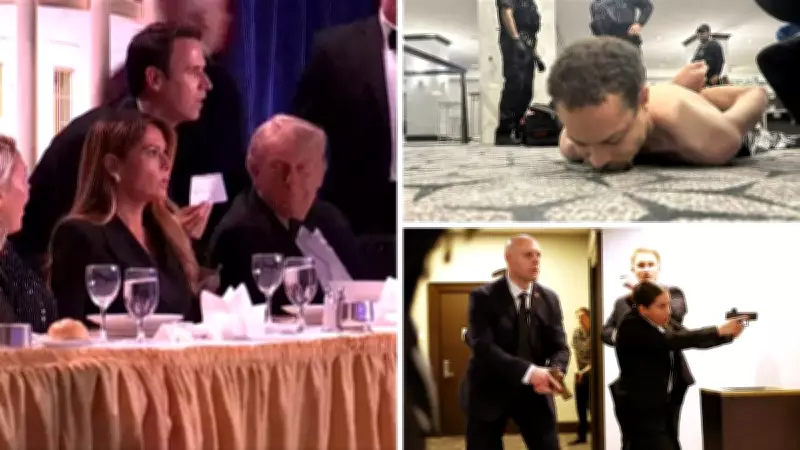
The attempted assassination of US President Donald Trump over the weekend has sparked a wave of conspiracy theories online, with many claiming the entire incident was staged. White House Press Secretary Karoline Leavitt's pre-dinner comments to Fox News, where she mentioned 'shots fired,' have fueled speculation. Additionally, the calm demeanor of some dinner guests, such as talent agent Michael Glantz who continued eating during the chaos, has been cited as evidence of a setup.
What Happened
Cole Tomas Allen, 31, allegedly stormed the lobby outside the White House Correspondents' Dinner armed with guns and knives. He bypassed security but failed to enter the ballroom where President Trump, his wife, Vice President JD Vance, and high-profile journalists were dining. Allen exchanged gunfire with law enforcement before being tackled. Attendees were instructed to take cover under tables and were later evacuated.
Conspiracy Theories in the Spotlight
The primary theory circulating online is that the event was staged to generate sympathy for President Trump amid criticism over the Middle East conflict. Supporters of this theory point to Leavitt's remark: 'It'll be funny, it'll be entertaining. There will be some shots fired tonight in the room. So everyone should tune into it.' Another point is the apparent ease with which Allen bypassed security, which some believe was intentional to justify a new, more secure White House ballroom.

Construction on a $400 million privately funded ballroom has recently begun, and President Trump mentioned the need for enhanced security shortly after the incident. Critics note that a judge had ordered a halt to construction due to lack of congressional authorisation. Additionally, unverified photos of Allen wearing an Israel Defense Forces sweatshirt have led to theories about a Zionist motive.
How Social Media Amplifies Conspiracy Theories
Dr. Neophytos Georgiou, a psychology lecturer at Flinders University, explains that conspiracy theories provide quick answers and soothe anxiety during major events. 'When a really big event happens, we feel the urge to find a really big answer,' he says. Social media algorithms create echo chambers, making it easier to encounter and believe such theories.
Dr. T.J. Thomson from RMIT University warns that while skepticism is healthy, excessive cynicism can harm society and democracy. He advises internet users to critically evaluate sources and consider their credibility before accepting information.
Despite the flood of theories, law enforcement officials have praised the Secret Service's response as a 'massive security success story.' Acting Attorney General Todd Blanche expressed confidence in their handling of the situation.