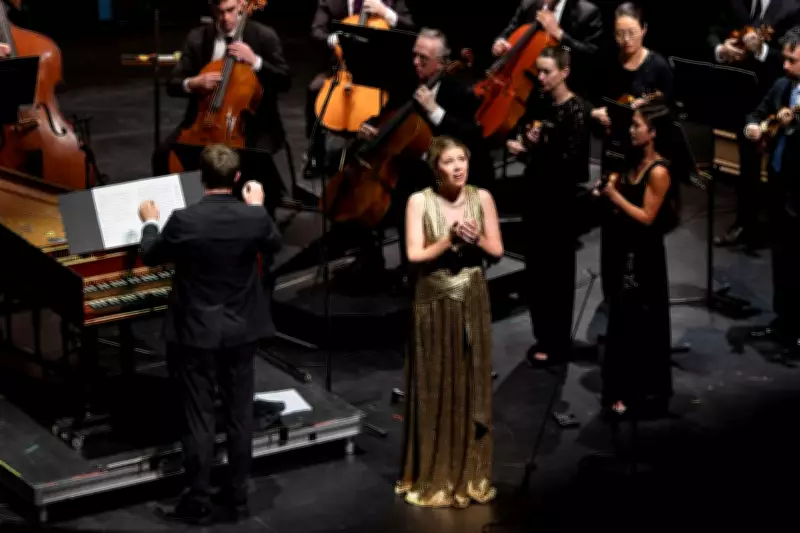
The WA Symphony Orchestra delivered a performance brimming with vim, vigour and virtuosity at their Masters of the Baroque: Heavenly Arias recital held on Thursday at His Majesty’s Theatre. Under the direction of harpsichordist Chad Kelly, alongside soprano Prudence Sanders, the evening was a celebration of Baroque mastery.
Handel's Overture and Sanders' Debut
The concert opened with Handel’s Judas Maccabaeus overture, its martial tones matching Kelly’s muscular gestures that rippled energetically across the stage. This piece, composed to commemorate the Battle of Culloden, celebrates Jewish military triumph. A lively second theme in the violins ignited a wildfire through the ensemble, with stark strings and incisive oboe playing that, in Kelly’s words, “moved, engaged and delighted” the audience, culminating in a gracious cadence.
Continuing with Handel, Sanders appeared in a gold robe that complemented the filigree finery of her vocal highlights. Her rendition of Tu del ciel ministro eletto from the oratorio Il Trionfo del Tempo e del Disinganno showcased agile and effortless phrasing, beautifully paired with violinist Alexandra Isted.

Drama and Silences
Drama in voice and gesture was matched by Isted’s silky skills, with Kelly chiming in on harpsichord—the harmonic heartbeat of Handel’s era—towards another gracious conclusion. The mood cooled with gentle pizzicato and a sylph-like melody that introduced an ethereal soprano for Un pensiero voli in ciel from the cantata Il delirio amoroso, looping and sustaining through the upper register over delicate strings and harpsichord. Immersive silences offset the inexorable beauty of the music, as Kelly shaped sound with deftly minimal direction to coax a crystalline cadence.
“You see what I mean about sopranos from Perth?” Kelly quipped in admiration before jagged orchestral chords snapped the mood to Corelli’s Concerto Grosso in G minor. Isted featured again, this time with fellow violinist Kylie Liang; the pair spun lithe melodic lines over Rod McGrath’s constantly striving cello in a dazzling trio display. Broader rhythms prevailed briefly, breaking into a frenzy and back to calm reflection, underscored by a perpetuum mobile in cello before settling in unity across the stage. Renewed drama from the ensemble sustained constant energy from the trio, relaxing into a pastoral interlude full of euphony before the many moving parts coalesced to close in perfect synchrony.
Bach's Harpsichord Concerto
After the interval, Kelly took the lead with JS Bach’s Concerto for Harpsichord in D minor. A compelling peal of notes from the keyboard ebbed and flowed in understated elegance through the opening Allegro movement. Kelly stood to conduct the mysteriously sinuous introduction to the Adagio second stanza, alternating hands on the keyboard with breaks to encourage his charges amid scintillating solo exposition. Robust ensemble and harpsichord set a stimulating pace for the Allegro finale. Lightning flashes on the keyboard matched quicksilver digital page turns as Kelly flipped between 18th and 21st century technology, sprinting through cadenzas to launch one final collective flurry and hearty applause.
Pergolesi and Graun
A much larger group took the stage for Pergolesi’s Sinfonia from Adriano in Siria, an operatic overture by turns athletic and lyrical, giving way to stately dance. That framed Sanders’ return for Carl Heinrich Graun’s programmatic portrayal of a storm-battered ship in Tra le procelle assorto from Cleopatra e Cesare. Florid in ornament, laced with wit and wiles, Sanders seemed to glide through the demanding yet beguiling narrative with commanding poise and presence.

Biber and Telemann
Heinrich Biber’s Battalia a 10 passed the baton back to the orchestra, a return to martial themes echoed through harsh “col legno” beating of bows on strings in another programmatic vignette. Chaotic carousing ensued as the warriors wet their whistles in reckless revels, giving way to distant drums in double bass. Biber never let the mood settle, driving the ensemble through episodic outbreaks both elegiac and ebullient, wistful and warlike, spicing the mix for a fiery parting salvo. Closing out, Telemann’s Overture-Suite in G major, “La Bizarre: Rossignol” cooled the mood, first in sorrow then in joy, to finish on a dramatic dismount.
Masters of the Baroque is repeated on Friday, April 24.