If you have been following the news, then you will be very familiar with the Strait of Hormuz. The narrow body of water that separates the Persian Gulf and the Gulf of Oman has been at the centre of blockades and negotiations amid the ongoing Middle East war. But there is another strait which, if closed, would have a far larger impact on Australia than Hormuz.
What is the Strait of Malacca?
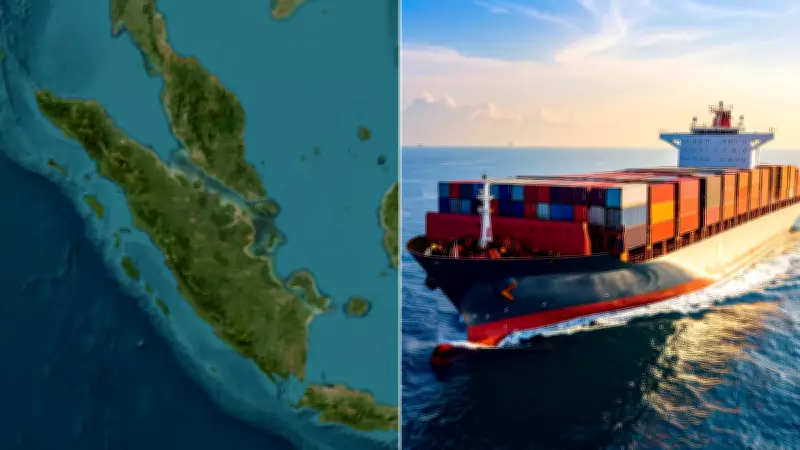
The Strait of Malacca is a roughly 900-kilometre-long shipping lane that sits between the Malay peninsula in the north and the Indonesian island of Sumatra in the south. It is just 2.8 kilometres wide at its narrowest point, compared with Hormuz's 39-kilometre-wide chokepoint.
Why is it so important?
The Malacca Strait is the shortest sea route between the Indian and the Pacific Oceans, making it the default trade corridor between east Asia and western countries. Malacca is also the primary route for Middle Eastern energy supplies — primarily much-lauded oil — to reach the powerful northeast Asian economies such as China, Japan and South Korea. The Strait carries nearly 24 per cent of global seaborne trade by volume through its protective walls, according to a UN report.

That includes 45 per cent of the world's seaborne oil, more than 25 per cent of all cars traded internationally and 23 per cent of dry bulk cargo such as grains and soybeans. The Malacca Strait directly services Singapore, the second busiest container port in the world after Shanghai, which sits at the eastern end of the strait. Singapore is also the world's largest trans-shipment port, responsible for redistributing cargo between ships and linking about 600 ports around the world.
Why are people talking about it?
Indonesia's Finance Minister Purbaya Yudhi Sadewa made headlines in late April when he suggested a toll for ships travelling through the Strait of Malacca, similar to Iran's control over the Strait of Hormuz. "Iran is now planning to charge ships passing through the Strait of Hormuz," he said. "If we split it three ways — Indonesia, Malaysia, and Singapore — it could be quite substantial." He quickly clarified his statement was a joke, given a toll such as that is not allowed under international law. "If only it could be like that. But it is not like that," Purbaya said.
Singapore's Foreign Affairs Minister Dr Vivian Balakrishnan had already ruled out any would-be toll on the strait, saying: "The right of transit passage is guaranteed for everyone. We will not participate in any attempts to close or interdict or to impose tolls in our neighbourhood." Despite no move to close or toll the Strait of Malacca, it does beg the question: What would happen to global trade if it were closed?
The importance of the Strait
Looking at the Strait of Malacca on a map, you would be forgiven for thinking it would be fairly inconsequential if it were to close. Unlike the Strait of Hormuz, which is the only sea route from the Persian Gulf into the Gulf of Oman, there are multiple other channels leading from the Indian Ocean to the Pacific Ocean and northeast Asian countries. The next fastest route from the Indian Ocean is under Sumatra and through either the Lombok or Sunda Straits. However, this journey would add an extra 1,800 kilometres — roughly three to five days of travel — to a ship's journey, increasing costs significantly and depriving the ship access to Singapore's port, which acts as a critical safe harbour and refuelling station. Thus is the importance of the Malacca Strait emphasised.
If the Strait of Malacca were to be closed, it would be detrimental to Australia and other Asia-Pacific nations, according to Australian Strategic Policy Institute senior fellow Dr Euan Graham. "In the worst-case scenario, if shipping were to be blocked, it would have a very significant effect on many countries — not just China, Japan, South Korea. Australia would be negatively impacted," he said. "It has a ripple effect that would run worldwide."

China is very aware of the strategic importance of the Strait of Malacca. In 2003, then Chinese president Hu Jintao used the phrase "Malacca Dilemma" to describe the risk of purely relying on the strait for trade. Almost 80 per cent of China's imported oil travels through the Strait of Malacca, meaning if it were blocked or tolled, it could have serious consequences for the nation's economy. China has invested heavily in establishing alternative supply routes, including through pipelines such as the Eastern Siberian-Pacific Ocean pipeline from Russia, however more than 50 per cent of its oil supply still comes from the Middle East.
Is the Strait of Malacca ever likely to be closed?
Closing or tolling the strait is illegal under international law, meaning Indonesia, Malaysia and Singapore are obligated to keep it open. So, its possible closure is unlikely. However, Graham says the ongoing blockade in the Strait of Hormuz highlights Malacca's importance and Australia's vulnerability if it were to be closed. "To state the obvious, Australia is an island before it's a continent," he said. "We, more than most countries, are dependent both on the sea for exporting our mineral wealth but also we've had a wake-up call that we depend on it for our fuel."
Graham says several major events in the past few years have emphasised the fragility of the maritime infrastructure that Australia and the world rely on for everything. "COVID was the first rehearsal. This Iran war is the second rehearsal," he said. "I believe it's kind of getting us ready for a more serious scenario in this region, in which case, if we do have a large-scale maritime conflict then choke points such as the Malacca Strait will be a focus for military strategy again."