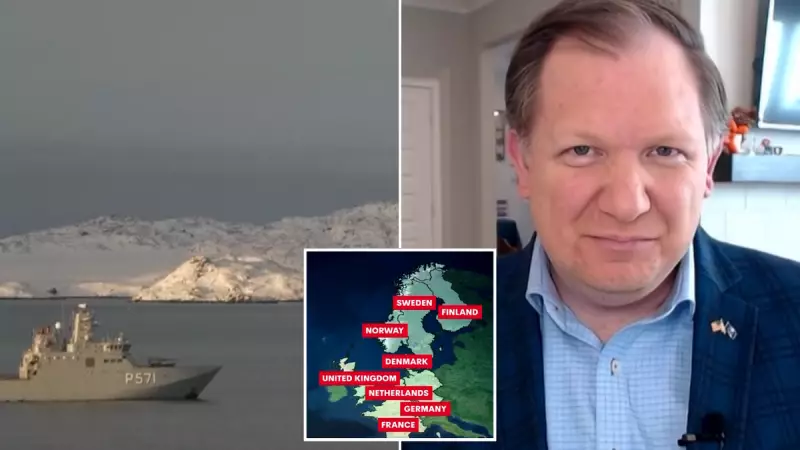
European leaders are pushing back against what they see as economic blackmail from the United States, after former President Donald Trump threatened sweeping new tariffs on nations opposing a US takeover of Greenland.
Trump's Tariff Leverage for Arctic Ambitions
Former White House spokesperson Pete Seat told Channel 7's Sunrise program that Trump is using tariffs as a blunt instrument to force a deal for the Arctic territory. Seat argued the move reflects Trump's long-held belief that economic pressure can be used to deliver political outcomes.
EU officials convened for emergency meetings on Monday after Trump warned eight nations they would face new import taxes. The countries targeted are Denmark, Norway, Sweden, France, Germany, the United Kingdom, the Netherlands, and Finland.

The proposed tariffs would start at 10 per cent from next month, escalating to a punishing 25 per cent by June. Trump declared the measures would remain until a deal is finalised for the "complete and total purchase" of Greenland, which he claims is a national security necessity for the United States.
European Unity and Greenland's Resistance
The threats have been met with firm resistance in Europe and on the ground in Greenland. Protests have erupted in the autonomous Danish territory, where many residents have reportedly rejected the idea of becoming part of the US.
Seat detailed Trump's strategy, stating, "President Trump knows that NATO can only exist with the United States participating, and he is using all the tools at his disposal, and the leverage that he has, including tariffs, to try and get what he wants. And that is Greenland."
He added that Trump operates on the principle that "money controls everything", a tactic that has sometimes worked with tariffs in the past. "Sometimes, when he throws spaghetti at the wall, he gets what he wants," Seat said. "So far, it’s not working with European allies."
A Strained Alliance and the Path Forward
Seat noted this dispute marks a significant escalation from tensions during Trump's first term, moving beyond previous warnings about NATO abandonment. European leaders have cautioned that the threats risk severely damaging the Western alliance and could inadvertently benefit geopolitical rivals like Russia and China.
According to Seat, Trump has already exhausted traditional pressure tactics, including demanding Greenland and threatening military action, without success. He suggested that if Trump is serious, the only viable path is diplomacy, not coercion.
"I think the best path forward for the United States, if the president is serious, is to make a cash offer to guarantee security and give the people of Greenland the independence they seek from Denmark, and then the key part is to accept their response," Seat advised.
He also highlighted Trump's preferred negotiation style, where he waits for the other party to initiate talks. "He wants Greenland to come to him ... he loves when people come to Mar-a-Lago or the White House to grovel at his feet," Seat remarked.
Australian Deputy Prime Minister Richard Marles, also speaking on Sunrise, stated that the future of Greenland is "fundamentally a matter for Denmark and Greenland". He declined to engage in a running commentary on US-Europe relations but expressed confidence in NATO's continued strength and unity.
EU leaders are now expected to outline a formal response following their emergency talks, as fears grow that the standoff could spiral into a broader trade and security crisis between the long-standing allies.