Australia Day Demonstrations Turn Heated Outside Parliament House
Canberra's political heart became a battleground of competing ideologies on Monday as opposing protest groups clashed dramatically in front of Parliament House. The confrontation unfolded on January 26, Australia's national holiday, with tensions running high between those advocating for changing the date and others protesting immigration policies.
Confrontation at the Nation's Political Epicentre
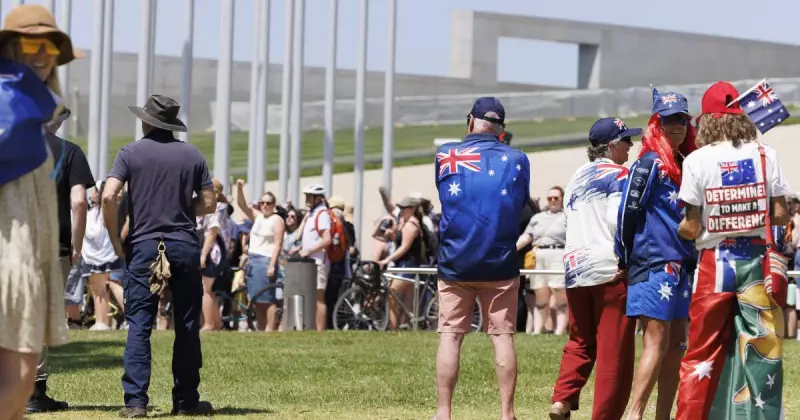
Hundreds of demonstrators from both sides gathered at the parliamentary precinct, separated only by plastic barricades and a substantial police presence. The Invasion Day rally, which began at Garema Place and proceeded to the Aboriginal Tent Embassy via Parliament House, attracted approximately six hundred participants. Simultaneously, about one hundred fifty people assembled for the March for Australia demonstration, an anti-immigration rally that commenced outside Parliament House before moving toward Yarralumla.
At one particularly tense moment, Invasion Day protesters encircled the March for Australia group on the parliamentary lawns, creating a volatile standoff that required police intervention to maintain separation. Officers formed a protective ring between the factions as participants from both sides armed themselves with megaphones and microphones, shouting insults and chanting loudly across the police lines.

Police Response and Arrests
ACT police confirmed responding to at least one significant incident during the protests, resulting in the arrest of a 37-year-old man. Authorities indicated that further enquiries were pending regarding the altercation. Despite the heated exchanges and physical proximity of the opposing groups, police described the overall crowd as generally well-behaved given the circumstances.
The security operation necessitated temporary closures of parts of Commonwealth Avenue and the adjacent bridge to accommodate the separate marches and ensure public safety. Dozens of officers were deployed to manage the situation throughout the day.
Divisive Figures and Controversial Symbols
The March for Australia rally featured several controversial elements that drew particular attention. Snowy Mountains councillor Andrew Thaler, who has previously faced suspension from his role for misconduct, addressed the anti-immigration gathering. His participation added to the controversy surrounding the event.
Further concerns emerged when observers noted one protester wearing a black Helly Hansen shirt, attire that has become associated with neo-Nazi groups at recent public demonstrations in Australia. This visual element underscored the extreme positions represented within the anti-immigration contingent.
Messages from the Protest Camps
The Invasion Day rally organizers framed their demonstration as an act of solidarity with Aboriginal and Torres Strait Islander peoples, explicitly calling for participants to "reject the celebration of colonization" on Australia Day. Their message centered on historical injustice and the need for national reckoning with Australia's colonial past.
Conversely, March for Australia materials argued that government policies promoting "Modern Australia" were eradicating national identity and compromising safety. This rhetoric reflected broader debates about immigration, multiculturalism, and national values that have polarized Australian society in recent years.
Momentary Unity Amidst Division
Despite the prevailing tension, a brief moment of connection emerged when two women from opposing protests linked arms and engaged in conversation. "I love you guys," declared one participant from the March for Australia rally, while her counterpart from the Invasion Day demonstration responded, "We're all one."
The Indigenous woman added, "Us Aussies and us Blackfellas got to stick together," acknowledging her own mixed heritage with the statement, "I have white ancestors too." This fleeting interaction highlighted the complex personal dimensions underlying the political divisions on display.

Community and Political Condemnation
The March for Australia rally faced swift criticism from multiple community organizations and political entities. The Canberra Multicultural Community Forum joined the ACT Human Rights Commission in condemning the anti-immigration demonstration, expressing concern about its impact on social cohesion.
The ACT Greens issued a particularly strong statement, describing the rally as emboldening "real and dangerous harm." A party spokesperson asserted, "This racist and divisive rhetoric has no place in our multicultural society. Every Canberran has the right to feel safe, secure and supported in the city they call home, and any attempt to undermine that must be called out in the strongest of terms."
Broader Implications for National Discourse
The confrontations at Parliament House reflect deepening societal divisions surrounding Australia Day, immigration policy, and national identity. As the annual debate about changing the date intensifies, and concerns about immigration continue to polarize communities, such public demonstrations highlight the challenges facing Australian social cohesion.
The events in Canberra serve as a microcosm of national tensions, playing out literally on the doorstep of the nation's political leadership. With arrests made and strong condemnations issued from multiple quarters, the Australia Day protests have once again demonstrated how historical commemoration and contemporary policy debates intersect in volatile ways within the Australian public sphere.