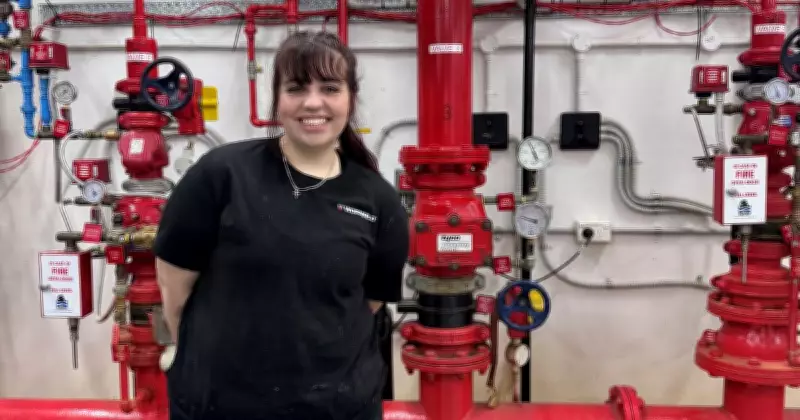
For many young Australians, the transition from high school to the workforce follows a predictable path. For Montanna Weir, a 21-year-old resident of Chisholm, that path originally led to a hair salon. Armed with a pair of scissors and an eye for style, she began an apprenticeship in hairdressing, believing she had found her lifelong calling. However, the reality of the industry didn't quite match the dream. Feeling disillusioned and yearning for a more robust, "in-demand" career, Montanna made a radical decision: she traded her shears for a pipe wrench.
Today, Montanna is a second-year apprentice sprinkler fitter at Wormald, a leader in fire protection. In a field traditionally dominated by men, she is part of a small but significant wave of women redefining what "trade work" looks like in the 21st century. Her journey from the styling chair to the rooftops of Parliament House is a testament to the changing landscape of vocational training and the critical importance of the fire protection industry.
A spark of inspiration
The pivot from hairdressing to fire protection might seem like a leap across a vast canyon, but for Montanna, the connection was closer than it appeared. Her father was already working as a sprinkler fitter at Wormald, providing her with a unique window into the industry.

"I'm a hands-on person by nature, but never did I imagine I would be in the same trade as my dad," Montanna admits. Seeking a fresh challenge and the security of a booming industry, she applied for an apprenticeship. Looking back, she describes the move as the "best decision of my life."
However, breaking into a male-dominated trade wasn't without its hurdles. In the early days, Montanna faced the "invisible barrier" of gender bias. "It was hard at first; I wasn't always taken seriously as a female when I turned up to jobs. Some people would even ask if I was the receptionist," she recalls. But as she continued to show up and demonstrate her technical proficiency, the skepticism faded.
The TAFE NSW edge: professional training
A critical component of Montanna's success is her training through TAFE NSW Randwick, a leading provider in the fire protection field. Montanna is undertaking a structured course that leads to a Certificate III in Fire Protection, a nationally recognised qualification.
Every month, she travels for a one-week "block" of face-to-face training. This intensive format allows her to balance full-time employment with the theoretical and practical education required for her trade. At TAFE, Montanna gains a comprehensive understanding of the systems that keep the public safe, covering:
- System Maintenance: Servicing and maintaining fire suppression systems, including hydrants and hose reels.
- Cross-Disciplinary Skills: Gaining insights into plumbing and construction fundamentals.
- Core Units: Completing essential units fundamental to achieving industry competency and qualification standards.
Certification and accreditation: the FPAS pathway
In the fire protection industry, there is a distinct pathway between becoming a qualified tradesperson and an accredited professional.
Trade Qualification: Completing a Certificate III in Fire Protection CPC32820 through a Registered Training Organisation (RTO) like TAFE NSW qualifies an individual as a skilled sprinkler fitter.
Professional Accreditation: Beyond the trade, the Fire Protection Accreditation Scheme (FPAS) sets the benchmark for individuals and companies. This accreditation ensures that practitioners who endorse fire safety statements have demonstrated the specific skills and knowledge required by law.
For apprentices like Montanna, completing the trade certificate is the essential first step toward achieving future FPAS accreditation, which allows for advanced career progression in inspection and regulatory compliance.
An industry in high demand
The fire protection services market in Australia is currently valued at approximately $4 billion annually. This growth is driven by stricter building codes, ageing infrastructure, and a construction boom in high-rise residential developments.

Despite this, the industry faces a dire talent shortage. Sprinkler fitting has been on the Occupational Shortage List for four consecutive years. This creates a golden opportunity for apprentices, offering job security and a clear path to high-paying roles. Peter Edmonds, a teacher at TAFE NSW Randwick, notes: "A number of our graduates are able to open their own businesses as soon as they qualify."
Protecting the heart of the nation
Working in Canberra means Montanna's "office" often includes the halls of Parliament House. She is actively involved in fire protection inspection and testing, ensuring compliance with industry standards. Her role includes verifying the operational reliability of control equipment and inspecting passive fire systems like smoke containment products.
"I get to work in some cool places... and it's good to know the work I do is protecting people's lives," she says.
By combining the mentorship of her father, hands-on experience at Wormald, and formal education at TAFE NSW, Montanna has built a foundation for a future that is, quite literally, fireproof.
Quick facts: fire protection industry in Australia
- The market is valued at approximately $4 billion annually.
- Stricter building codes and infrastructure upgrades drive growth.
- Sprinkler fitting has been on the Occupational Shortage List for four years.
- Apprentices enjoy job security and high earning potential.