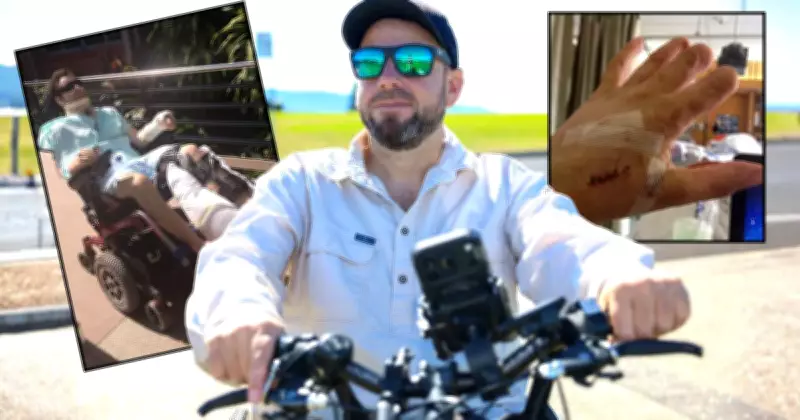
Paul Harju was simply going about his life, fit and healthy, before a near-fatal road accident in October 2012 spun his world into disarray. His journey in the 14 years since has been eye-opening, and recent scrutiny of the Illawarra's lacking activity levels is something the now-43-year-old can speak on from a unique angle.
The former mines worker was struck by a car while riding his motorbike along a semi-isolated road in Cairns. Harju's spinal column was crushed, as were the bones in his hand. His neck, hand, wrist and one leg were also broken. He suffered cuts, bleeding behind the eye, and deep gashes down all limbs.
It had been flagged from the beginning, when Harju woke without feeling from the chest down, and again after a 12-hour-long surgery days later: his rehabilitation would be long. Some of his first words posted to a recovery-dedicated Facebook page were that he "felt like a prisoner trapped" in his own body. It wasn't until May 20 the following year that Harju was released from hospital.

The self-titled nomad now spends most of his time travelling across Australia while YouTubing life as a T3 paraplegic; showing a perspective often missed by the able-bodied. He currently lives in Wollongong. In the wake of the Illawarra being placed under the microscope as an "unfit" region, Harju shed light on how flaws in the fitness world are affecting residents with a disability.
Accessibility Challenges in Wollongong
Identifying shortcomings is only one piece of the puzzle. It may not lead to much change given what stands in the way. A tropical paradise often overlooked for Australia's larger cities, it's Cairns that leads the charge when it comes to fitness accessibility. Spinal Life Healthy Living is a fully-equipped gym and accommodation centre for people with ranging levels of mobility. But there's only one other like it in Australia, it too located in southeast Queensland.
What it would take - and cost - to bring a Spinal Life Centre to NSW, let alone Wollongong, is unknown. In the meantime, the city has been singled out for underperforming in other ways. Harju has noticed a lack of outdoor space conducive for wheelchair users. Paths are uneven; they're hilly; they're slanted. With the exception of the Blue Mile strip, he highlighted how it's near-impossible to wheel himself more than 50 metres before being out of breath.
Gym Equipment: A Costly Barrier
And gyms? They're a complete no-go. Commercial gyms offer none of the specialised equipment designed for wheelchair users. And while it locks Harju out of a big portion of the fitness world, he understands why. A single machine can cost upwards of $25,000. He knows this, because at one point it was viable to install a hand-powered stationary bike in-home. That was until the quote came in at $29,500.
"It's not worth it to them," Harju said of gyms neglecting the pricey investment. "For sure, that would be great, but I understand why they don't. There's not many people like me getting around and the equipment is very specific, specialised and expensive. That's why they don't have it. It's just not feasible," he said.
Feasible or not, Harju was a consistent gym-goer prior to the life-altering ordeal in 2012. "Before my injury, I was a real regular ... worked in the mines and would go to the gym at least three or four times a week," he said. Having that access stripped away has not been an easy thing to accept as the years go by. "It affects every part of your life."
The lack of accessible fitness options in Wollongong not only impacts physical health but also mental well-being. Harju's story underscores a broader issue of inequality in fitness infrastructure, where disabled individuals are often left behind due to high costs and limited demand. Until more inclusive facilities are developed, many like Harju will continue to struggle to maintain their health and independence.