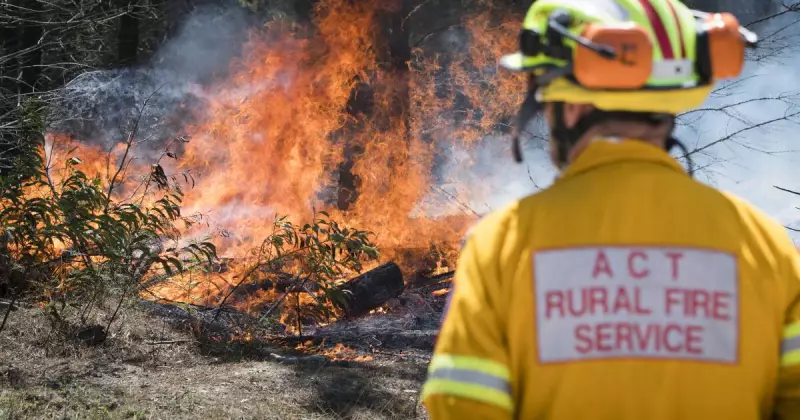
The recent bushfires that ignited west of Canberra earlier this month bore an unsettling resemblance to the beginnings of the capital's most devastating natural disaster in 2003, according to the ACT Rural Fire Service chief.
Eerie Parallels Between Two January Events
On January 3, 2026, the ACT Rural Fire Service detected three fires in remote, inaccessible areas of Namadgi National Park. Shortly after detection, one of these ignitions sparked a fourth blaze. This scenario mirrored events from January 8, 2003, when fire tower operators monitoring for smoke signs detected dry lightning strikes in the same national park.
What began as four separate fires in remote bushland in 2003 transformed over ten days into a single roaring inferno that engulfed Canberra city. That disaster claimed four lives, injured hundreds of people, and destroyed more than 500 homes.

The Perfect Storm of 2003
ACT Rural Fire Service Chief Rohan Scott, who was among ground crews during the 2003 catastrophe, described January 18, 2003 as featuring "some of the lowest humidity, highest temperatures and strongest winds" creating what he called "the perfect storm."
On that fateful day, Canberra resident Tom Bates captured the first documented fire tornado on the planet using his video camera. His footage shows a tornado of smoke, generated by the roaring blaze, consuming goalposts on a playing field as Bates exclaimed "this is bad news."
"The fire was so strong it created its own fire weather," Mr Scott recalled. "It had lightning, it created its own vortex which then had a tornado that came off Mount Arawang and went through Kambah and destroyed some houses, not from fire, but from the tornado itself. It actually had the smoke plume go up into the stratosphere."
Swift Response to 2026 Ignitions
Comparing the 2003 events to bushfires in Namadgi National Park earlier this month, Mr Scott noted "very similar types of fires" with dry lightning storms causing multiple simultaneous ignitions. A crucial lesson from 2003 has been to suppress bushfires as rapidly as possible, which prompted the ACT RFS to deploy all available resources against the four ignitions detected on January 3 this year.
Despite operating with minimal staff during the weekend following New Year's Day, the service successfully managed the fires, with Mr Scott describing the mood at headquarters as "very relaxed." He credited this to having "some very experienced people" on the team.
Within four days of detection, a coordinated multi-agency response contained the fires near Bendora Dam and Cotter Hut, areas accessible only by helicopter and boat. More than 100 personnel participated in firefighting and communication efforts, including 75 ground personnel, approximately a dozen incident management team members, and emergency services agency media officers.
Timely Intervention Before Heatwave
Days after containment, Canberra experienced a severe heatwave with temperatures reaching 39 degrees on two consecutive days. Mr Scott emphasized that "if we had let them burn, then there would have been a threat with those weather conditions we had coming up in a few days."
"The ACT community is quite vigilant when it comes to the impacts of fire, and we didn't want to see the community feeling threatened in any way," he explained. "So that's why we put as many resources as we could onto those fires in the early stages."
Two Decades of Firefighting Evolution
Over the past twenty-three years, significant advancements have transformed fire detection, prediction, mapping technology, and radio communications. The ACT RFS now operates with a larger fleet, three contracted helicopters, and additional remote area teams, substantially enhancing their firefighting capacity.
Mr Scott highlighted that learning extends beyond the 2003 fires to include the Black Summer fires of 2019-2020, with fire services locally and nationally sharing experiences and benefiting from increased research and investment in better capabilities and tools for firefighters.

"We've come a long way in those 23 years, but on that day in 2003 every firefighter did their absolute best with what they had," he acknowledged. "We need to also highlight that those conditions on that particular day was some of the worst fire conditions that have been experienced anywhere in the world, not just Australia."
Volunteer Foundation of Emergency Response
The RFS remains predominantly volunteer-based with 550 dedicated volunteers, expanding to more than 1500 when including the State Emergency Service, community fire units, and maps volunteers. Mr Scott expressed profound gratitude for this volunteer base that trains during off-seasons and remains available year-round to respond to fires, storms, floods, and other emergencies.
With a severe heatwave forecast for the territory and the second total fire ban of the year now in effect, fire services maintain emergency readiness while urging community members to prepare accordingly.