Western Mines Group has delivered a major breakthrough at its flagship Mulga Tank nickel project in Western Australia, punching a deep drill hole into what is now considered a globally significant nickel sulphide system.
A Deep Dive into High-Grade Mineralisation
The ASX-listed junior explorer has completed its final drill hole for 2025 at the Eastern Goldfields site, achieving an impressive depth of 1,437.5 metres. The hole intersected a remarkable 900 metres of nickel-bearing ultramafic rocks, significantly boosting confidence in the project's scale and quality.
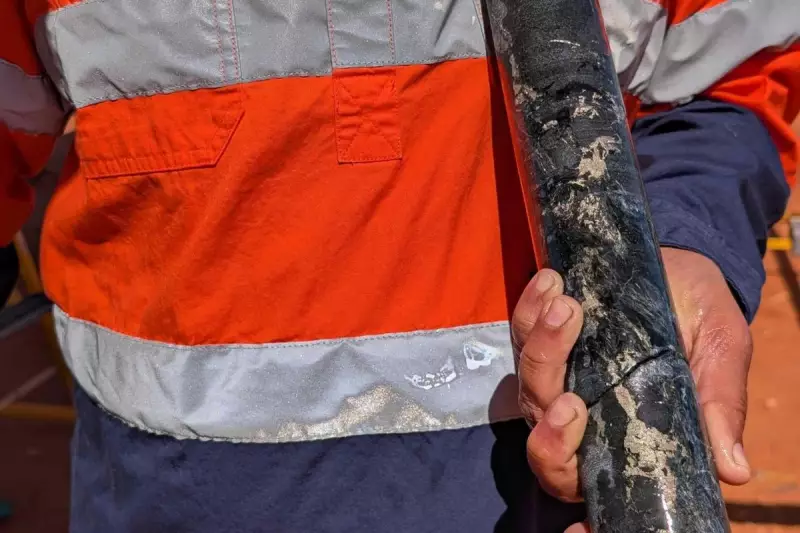
From a depth of 522 metres down to the end of the hole, the drill bit cut through high-magnesium oxide dunite containing disseminated nickel sulphide mineralisation. The interval also contained numerous high-grade, remobilised massive sulphide veinlets and segregations. Portable XRF readings on site recorded nickel values as high as 55 per cent, highlighting the exceptional tenor of the mineralisation found at depth.

Building a World-Class Resource
These latest results strongly support the company's exploration model for a Perseverance-style hybrid system. This model envisions a large, disseminated sulphide body sitting above a basal accumulation of massive sulphides.
Drilling was halted at 1,436 metres after intersecting what is believed to be the footwall of the system. Operations are scheduled to resume in mid-January, with plans for additional reverse circulation drilling to further test the extent of the mineralisation.
Adding significant value to the exploration program, the deep diamond drill hole was half-funded by the Western Australian Government’s Exploration Incentive Scheme, which contributed $220,000. This support allowed Western Mines to drill deeper than initially planned while managing its exploration budget effectively.
Excitement at the Basal Zone
Western Mines Group Managing Director Caedmon Marriott said the most exciting part of the hole was the final 100 metres. This section cut through a rich basal zone packed with high-grade, remobilised massive sulphide veining, along with chunky sulphide globules and segregations.
"There were some beautiful intersections of disseminated sulphide mineralisation down the hole, coarsening up to 10% in places in the lower portion," Marriott stated. He noted these geological features are consistent with being close to a primary massive sulphide source.
Through systematic drilling, Western Mines has steadily built the scale of the Mulga Tank project. The current contained metal inventory is substantial, including:
- 5.3 million tonnes of nickel
- 257,000 tonnes of cobalt
- 161,000 tonnes of copper
- 1.1 million ounces of platinum and palladium
The global-scale resource includes an indicated component of 565 million tonnes grading 0.28 per cent nickel, 134 parts per million cobalt, 104 parts per million copper, and 18 parts per billion platinum and palladium.
With thick, mineralised intervals continuing to emerge from deep drilling, Mulga Tank is positioning itself as a potential major supplier in a market hungry for large-scale sources of critical minerals. The nickel and cobalt found are essential for battery and clean energy technologies, placing the project at the forefront of the green energy transition.