The United States has launched fresh airstrikes across Iran this week as President Donald Trump, frustrated by protracted negotiations to end the war, turns to violence to pressure the Iranian leadership. US Defense Secretary Pete Hegseth warned that airstrikes would likely continue if the peace deal stalls, stating, "If we need to negotiate with bombs, we'll negotiate with bombs." This follows recent missile exchanges between Iran and Israel and Iran shooting down a US helicopter.
Until now, both the US and Iran had respected the precarious ceasefire that halted the war in early April. Trump insists a peace deal is imminent, but why are both sides firing on each other now, and what does this mean for negotiations? Several plausible explanations exist.
Escalate to Deescalate
In conflicts, states often escalate military action to intimidate the other side into submission. Both the US and Iran want to show force to pressure the other into accepting an agreement that meets their core interests. However, they remain at an impasse because their most critical interests clash. The US demands that Iran capitulate on its nuclear program and reopen the Strait of Hormuz unconditionally, while Iran wants its frozen assets released and a lasting ceasefire between Israel and Hezbollah in Lebanon. Both sides are far apart on the nuclear issue, with Iran unlikely to fully dismantle its nuclear infrastructure or cease uranium enrichment.

Given the stalemate, both sides signal willingness to escalate militarily, yet neither wants the ceasefire to collapse completely. Trump aims to move on from the war and shift the domestic political agenda in an election year. Fewer than one in six Americans believe the US is winning the war. The Iranian regime remains standing but cannot ignore mounting economic pressures. The problem is that escalation to intimidate only works if the other side is not pursuing the same tactic simultaneously. Otherwise, both end up in an escalation trap, unable to back down.
Accidental Escalation
Another explanation is that these escalations are unintended but inevitable consequences of a tense ceasefire involving a live military blockade in the Strait of Hormuz. It remains unclear if the Iranian drone that downed the US helicopter was intentional or accidental.
An Existential Regional Conflict
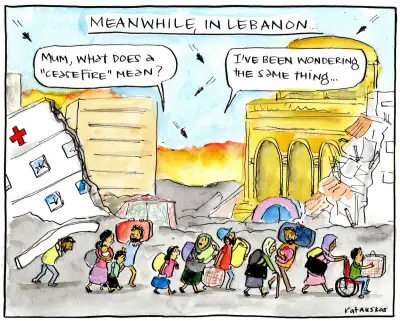
Adding complexity, Israel is simultaneously launching military strikes on Hezbollah in Lebanon. Israel's deep operation into southern Lebanon has shifted regional geopolitics and may undermine the tenuous US-Iran ceasefire. The Trump administration may not fully grasp that for Israelis and Iranians, this conflict runs deeper and longer than the current war. For both sides, it is existential. Iran has long opposed Israel's place in the region, and Israel has long viewed a nuclear-armed Iran as a chief survival threat. Iran will not abandon Hezbollah, which it has funded and armed, while Israel wages war in Lebanon, as the regime sees itself and Hezbollah as one front fighting the same battle.
On the Israeli side, the October 7, 2023 Hamas attacks fundamentally shifted Prime Minister Benjamin Netanyahu's approach. His far-right government has adopted an offensive strategy of capturing territory in Syria, Lebanon, and Gaza, establishing security buffer zones. Netanyahu vows to eliminate threats from Iran, Hamas, and Hezbollah. However, non-state actors like Hamas, Hezbollah, and the Houthis cannot be eliminated with conventional force; they can blend into civilian populations and reemerge later. Thus, despite significant Israeli military force and widespread destruction, Israel will not succeed in eliminating these groups and will keep fighting.
Trump's approach to regional diplomacy ignores these complexities. He relies heavily on bilateral and personal relationships, showing little interest in addressing the underlying drivers motivating multiple actors.

Will the Ceasefire Hold?
Understanding how Trump views a "ceasefire" is crucial. In a news conference, he said that in the Middle East, a ceasefire means "shooting in a more moderate manner." However, he does not want a return to full-scale war, as shown by his demand that Israel and Iran stop striking each other. So, we may see more strikes among the three sides as negotiations continue. A memorandum of understanding between the US and Iran may emerge in the coming days or weeks, but it would likely be an agreement to continue talking, not resolve core issues. Nor is Israel likely to withdraw from southern Lebanon or halt its asymmetric war with Hezbollah. As argued before, this has the makings of a "frozen conflict"—an unresolved war continuing at a low level below full-scale combat. If deeper roots are not resolved, a ceasefire between the US, Israel, and Iran can only be temporary.