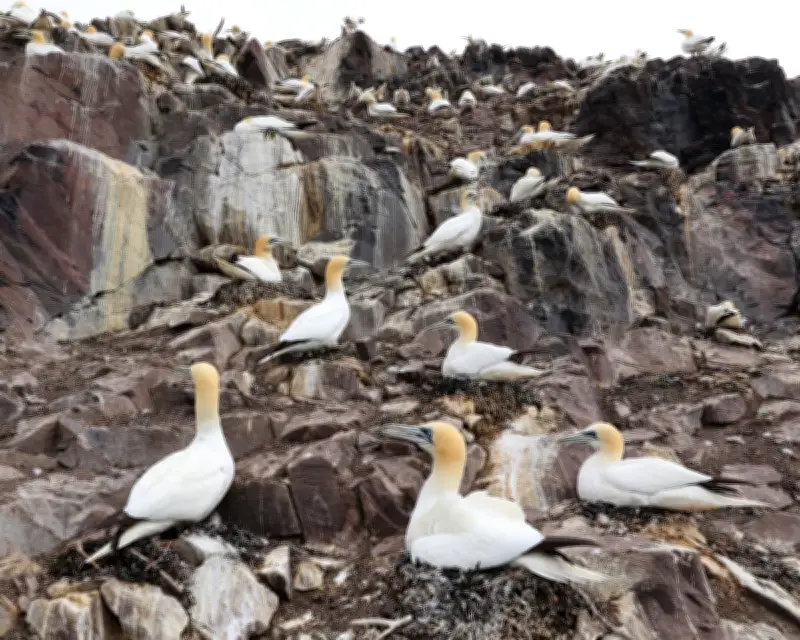
Animal welfare campaigners are calling for discussions to gradually phase out the controversial annual hunt for infant gannets, known as guga, on a remote Scottish island. OneKind and the League Against Cruel Sports have urged that the practice, which has been carried out for at least 400 years, be slowly ended through dialogue with the Hebridean islanders who view it as a cultural tradition and sustainable food source.
Both organizations expressed strong criticism of a recent "stunt-driven" campaign aimed at forcing a ban higher up the political agenda. The campaign, led by the anti-hunting group Protect the Wild (founded in 2015) and other activists, included a 60-hour occupation of the roof of NatureScot, the conservation agency that licenses the hunt, by the group Abolish the Guga Hunt. Additionally, Protect the Wild's founder, Rob Pownall, ran for election to the Scottish Parliament dressed as a gannet.
Protect the Wild also commissioned actor Brian Cox, known for his role in Succession, to narrate a graphic animated film condemning the practice. Cox described it as "needless cruelty," while Pownall stated, "Gannet chicks are being snatched from their nests and bludgeoned to death for nothing more than a tradition."

Robbie Marsland, director of the League Against Cruel Sports Scotland and a veteran of campaigns against Icelandic whaling and seal clubbing in Canada, argued that such tactics have been counterproductive, actually strengthening support for guga hunting on the Isle of Lewis in the Western Isles. Marsland noted that he supports two petitions calling for a ban—including one with 183,000 signatures launched by Protect the Wild—but believes the best approach is through dialogue, finding a solution that "honours and respects" the tradition.
"It's a hunt for food, no doubt about that," Marsland said. "It's not a sport, it's a tradition. People on Lewis don't think it's horrific."
A spokesperson for Protect the Wild defended their approach, stating that their "bold, creative approach" has brought the issue to national attention. "Bringing a hidden cruelty into the light is never comfortable, but it is necessary," they said. "Any issue that touches on culture, tradition and the treatment of animals will stir strong feelings on all sides. But we believe the public has a right to know what happens to wildlife in their country."
Guga hunting is unique in the UK as it has legal protection under the Wildlife and Countryside Act 1981 due to its deep historical roots on Ness, a peninsula in northern Lewis, and its role as subsistence food gathering. Murdo MacRitchie, a spokesperson for the hunters, described allegations that the harvest is barbaric as a distressing caricature.
"Like many rural communities, we live close to our sources of food. On our crofts, there are sheep, cattle and chickens. In the seas that circle us, we catch haddock, mackerel and ling. They are part of the food chain that has sustained island life for generations," MacRitchie said. "Capture to stunning only takes seconds, and the bird is dispatched immediately. There is no pleasure in that timespan. As with any animal raised or taken as food, this is the hardest part of the procedure, but it is undertaken as a serious responsibility and never as an act of cruelty."
NatureScot's board is expected to approve a fresh licence for this year's hunt, though it may further lower the cull limit after reducing it to 500 last year due to concerns about avian flu affecting the gannet population. Once a year, about 10 men sail to Sula Sgeir, an uninhabited island 40 miles north of Lewis, and traditionally camp there for up to two weeks in stone bothies. After the quota was cut to 500, last year's hunt became a much shorter daylong visit.
The guga—juvenile gannets that have not yet fledged—are caught on their cliffside nests using long poles with a retractable noose, then clubbed unconscious before being decapitated. The carcasses are cleaned, spatchcocked, singed over an open fire, salted, stacked, and left to dry. At their peak, about 2,000 prepared guga would be brought back. Considered a delicacy by aficionados, the intensely salty, fishy, and gamey flavour is an acquired taste, with novices often finding it repellent. Despite this, guga are shipped to customers worldwide.

In a new joint report, OneKind and the League Against Cruel Sports Scotland argued that the legislation is outdated, granting guga hunting privileges not allowed in any other animal-based food production, such as abattoirs. The report, by Lorna Young, presented evidence that the techniques are not humane, breaching key licence requirements, and that the hunt disturbs fulmars, European storm petrels, and Leach's petrels living on Sula Sgeir.
Young argued that the 1981 act and statutory protections under the Animal Health and Welfare (Scotland) Act 2006, currently under review, rely on imprecise definitions and are out of step with modern evidence on animal suffering, rights, and sentience. "There is no independent oversight or monitoring of the guga hunt, hampering any effort to undertake an animal welfare impact assessment. Indeed, given the Scottish government's public commitment to the evaluation of its policies, the lack of scrutiny of this licence condition appears particularly remiss," the report stated.
A NatureScot spokesperson said the agency will carry out a fresh gannet survey to check population stability. "We will assess the 2026 licence application carefully to determine if granting it will affect the long-term stability of the gannet population on Sula Sgeir, in accordance with existing legal frameworks," they said. "The assessment by NatureScot will be informed by the latest scientific evidence including an updated population viability analysis model."