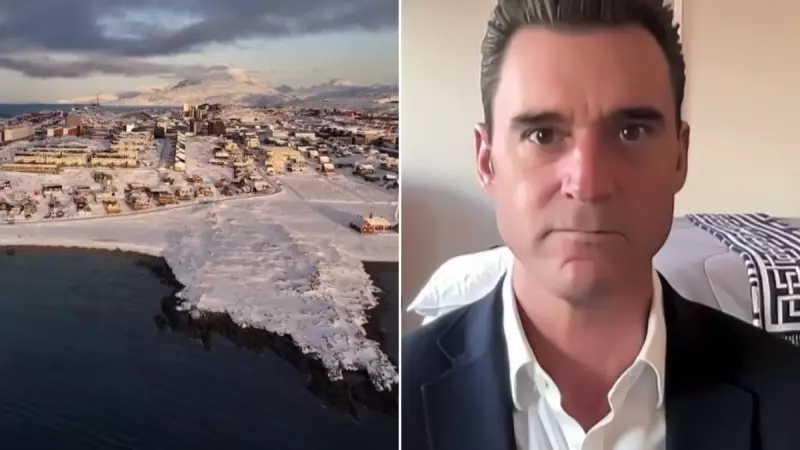
A top Republican strategist has issued a stark warning that US President Donald Trump's revived campaign to acquire Greenland has transformed from political rhetoric into a full-blown international diplomatic crisis. Matthew Bartlett described the move as ego-driven and profoundly damaging to America's relationships with crucial allies.
From Iran to Arctic Obsession: A Strategic Whiplash
Speaking to Sunrise on Tuesday, Bartlett highlighted the jarring shift in the administration's focus. "Last week, this town was poised to see if President Trump would take action against the evil regime in Iran," he said. "Now, this week, he’s talking about Greenland and the US taking it over."
Bartlett characterised Trump's latest comments as revealing "the unbelievable, tremendous downside" of his leadership style, a concern increasingly shared by European capitals watching his foreign policy manoeuvres.

The controversy intensified following reports that Trump sent a letter to Norway's Prime Minister, Jonas Gahr Store, directly linking his ambitions for the Arctic island to his frustration over not winning the Nobel Peace Prize. In the letter, Trump reportedly wrote that "considering your country decided not to give me the Nobel Peace Prize... I no longer feel an obligation to think purely of peace."
Prime Minister Store swiftly rejected the premise, clarifying that the Norwegian government plays no role in selecting the Nobel Peace Prize winner, which is decided by an independent committee.
A "Silly Obsession" Turns Serious
Bartlett expressed grave concern over the escalation, stating that what began as "a silly obsession" has now erupted into a significant diplomatic flashpoint. "It certainly seems as if this is ego-driven, much more so than any of the legitimate geopolitical issues regarding Greenland," he told Sunrise.
While security analysts broadly agree that enhanced cooperation in the Arctic region would benefit global stability, Bartlett argued that Trump's unilateral and aggressive approach is dangerously fracturing NATO unity. "Most people on both sides of NATO agree that more co-operation and co-ordination would be welcomed in the Arctic for global security, yet the president seems incredibly adamant on the US taking over Greenland," he explained.
He also noted a stark lack of public backing for the proposal, saying, "Outside of the Oval Office, there are not many people in the public who agree or even know what he’s talking about right now."
Unprecedented Tensions and Tariff Threats
Bartlett warned that the situation has moved beyond Trump's typical unconventional statements. "This is unlike anything we’ve seen before. We seem to be picking a fight with a NATO ally, arguably at the worst time possible," he said. "The president is unusual, but this is more than that — this is absolutely unwelcome."
The strategist's alarm comes as the standoff over Greenland intensifies. European leaders are reportedly refusing to capitulate despite facing economic threats from the White House. The US administration has warned eight European nations—Denmark, Norway, Sweden, France, Germany, the United Kingdom, the Netherlands, and Finland—that they could face new import tariffs of up to 10 per cent starting next month, potentially rising to a punishing 25 per cent by June.
This coercive economic pressure is conditional on these nations not agreeing to what Trump has termed the "complete and total purchase" of Greenland, a Danish autonomous territory. The move marks a severe test for transatlantic relations, blending territorial ambition, economic coercion, and personal grievance into a volatile diplomatic mix.