On the Mountain with a Monk: Discovering Yen Tu, Vietnam's Zen Buddhist Sanctuary
In the misty highlands of Quang Ninh Province, northeast Vietnam, the great mountain of Yen Tu stands shrouded in fog, its pine forests whispering secrets of centuries past. At 1068 meters above sea level, this peak is not only the highest in the Dong Trieu range but also the spiritual cradle of Vietnamese Zen Buddhism. Every year, millions of pilgrims ascend its slopes to reach a revered bronze pagoda at the summit, seeking enlightenment and connection.
Our journey to this sacred heartland began with unexpected weather—harsh winds and thick mist that forced the closure of the scenic cable car. This twist of fate, however, offered a profound lesson in one of Buddhism's core tenets: impermanence. As the Buddha taught, everything is changeable, and seasoned travelers know to adapt. Instead of climbing the mountain to meet a monk, the monk came down to us.
The Enlightened King and the Birth of Truc Lam Zen
In the lobby of Legacy Yen Tu—MGallery hotel, we were greeted by Thich Truc Tu Kien, a Truc Lam Zen Buddhist monk whose saffron robes glowed against the grey sky. Through a translator, he introduced himself: Thich, the surname for ordained Vietnamese monastics; Truc, for the Zen tradition; Tu, for the mountain; and Kien, meaning "seeing with the mind."

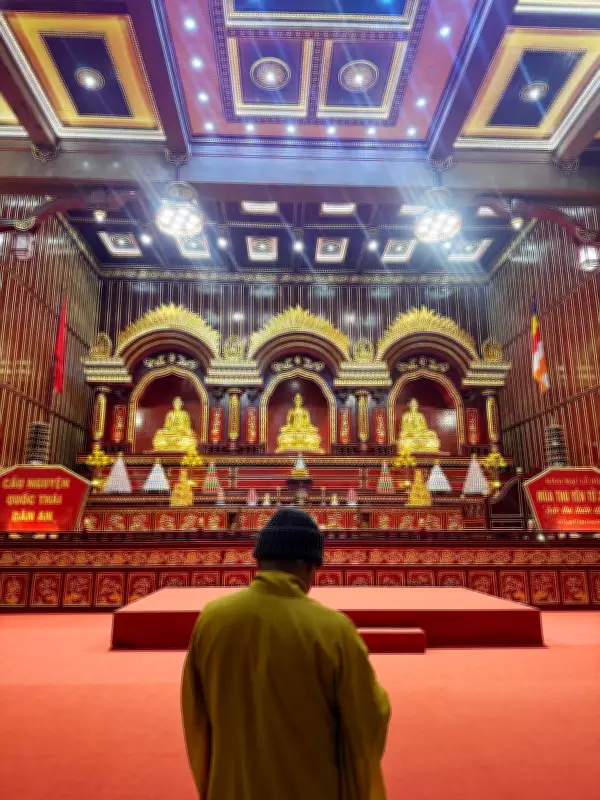
We were led into Truc Lam Palace, an ornate hall adjoining the hotel that can host up to 7000 people for religious festivals. Sitting on a platform adorned with gilded statues and lotus flowers, Tu Kien recounted the story of Emperor Tran Nhan Tong (1258-1308), the "Buddha Enlightened King." At just 20, he ascended the throne and led Vietnam to victory against Mongol invasions, but then made a radical turn. He abdicated, withdrew from court life, and retreated to Yen Tu to found Truc Lam, Vietnam's first indigenous Zen Buddhist sect.
Legend has it that upon reaching a stream at the mountain's base—a natural threshold into Buddha's world—the emperor urged his royal concubines to return home. In a tragic act of loyalty, many drowned themselves. Yen Tu's isolation became a contemplative space where Tran Nhan Tong blended Chinese and Indian Buddhist lineages with local traditions, creating a philosophy that emphasizes mindfulness, compassion, and enlightenment in everyday life. Today, Yen Tu is a UNESCO World Heritage Site, anchoring this legacy firmly in the present.
Lessons in Mindfulness and the Lotus Symbolism
As Tu Kien shared his wisdom, a sense of tranquil softness radiated from him. He became a monk at 20 and, after 25 years of study, now teaches meditation, adapting methods even for resistant students. "Our minds are always like a monkey," he said. "We are not focused, not stable. Meditation helps our mind become more calm, more clear. When we can see everything more clearly, our wisdom is bigger and we can solve problems more easily."
He urged us to remember that nothing is fixed—a truth underscored by the day's weather. "One of the laws of Buddhism is that everything is impermanent," Tu Kien explained. "Nothing stays the same. Even our body will be dead someday, but our mind lasts forever. To be happy, joyful, and peaceful, we need to practise coming back inside to ourselves."
Tu Kien meditates for two hours daily, sometimes longer, and even joked about occasionally falling asleep in the morning. The lotus pose, with each foot on the opposite thigh, keeps him stable. Lotus flowers, symbols of enlightenment emerging from mud, surrounded us in the palace. The saying "no mud, no lotus," popularized by Vietnamese monk Thich Nhat Hanh, reminds us that suffering can lead to true happiness. Tu Kien wishes for us to be like the lotus, thriving even on our darkest days.
Walking the Path of Release and Reflection
As the skies cleared, we ventured up the mountain with Tu Kien, following the same path taken by Emperor Tran Nhan Tong. We reached Suoi Giai Oan, the Stream of Release, where the concubines drowned. Crossing a bridge over the water, we reflected on their sacrifice. The king later held a ceremony to absolve their spirits and built a temple in their honor, now replaced by the Pagoda of Release, surrounded by ancient fruit trees like jackfruit, mango, and lychee.

We lit incense as Tu Kien prayed before a gnarled fig tree, where a scholar once claimed to see Tran Nhan Tong's ghost. This spot felt like a eternal watch over the women he loved. Here, Tu Kien bid us farewell, leaving a lasting impression of serenity and depth. As he departed, the mist settled, mirroring the calm within.
This journey to Yen Tu offers more than scenic beauty—it's a deep dive into spiritual heritage, mindfulness, and the enduring power of Zen Buddhism in Vietnam.