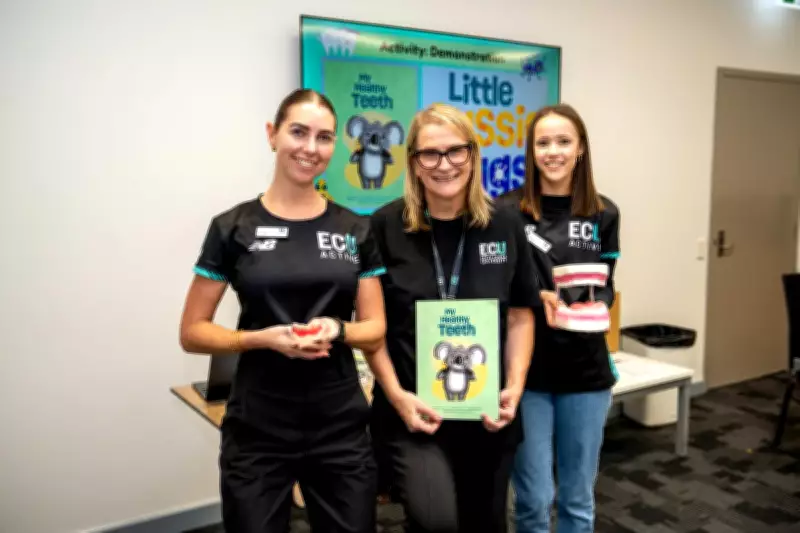
Camera IconLouise Miller, Dr Ruth Wallace and Caitlin Goddard from Edith Cowan University. Credit: Supplied
Bridging the Gap: ECU students take on childhood tooth decay in Stirling workshop
PerthNowPerthNow - Stirling7 May 2026, 2:00amCopy linkShare story

A recent workshop at Stirling Leisure Centre has shone a spotlight on one of the most common chronic conditions in young children, equipping parents with practical, hands-on education to combat early childhood tooth decay.
The session was delivered by two Edith Cowan University students, who focused on prevention, brushing habits, and diet in discussions with a group of migrant mothers.
The students, Louise Miller and Caitlin Goddard, are both in their final semester of a Bachelor of Health Science majoring in Nutrition Bioscience at ECU.
Ms Miller said she hoped the workshop would help instil good habits at an early age that would carry through into adulthood.
“Early childhood caries is the most common chronic condition in Australian pre-school children, affecting 8 per cent of children as early as 18 months old, with prevalence increasing significantly by the age of three years,” Ms Miller said.
“Unfortunately, there is confusion among caregivers around fluoride use, brushing practices and dietary sugars, so we wanted to share this information and make it simple to understand.”
Camera IconECU dental students Caitlin Goddard and Louise Miller. Credit: Supplied
The information session was arranged through Ishar Multicultural Women’s Health Services.
Ms Miller said the workshop allowed them to apply evidence-based research in a real-world, preventative health setting.
“We took up this project as a practicum opportunity due to its strong alignment with our interests in community nutrition and health promotion,” she said.
The students, alongside supervisors Dr Ruth Wallace and Dr Lesley Andrew, provided resources including the children’s book Little Aussie Bugs, toothbrushes, and toothpaste, and answered questions in a relaxed, face-to-face setting.
Dr Wallace said research showed many parents lacked awareness of evidence-based oral health practices, including diet recommendations.
“Oral health workshops for parents of children aged under five years are essential because ECC is common, preventable, and driven by caregiver knowledge, feeding practices, and access to consistent advice,” she said.
“Involving nutrition students in the design and delivery of these workshops builds workforce capacity while directly addressing inequities in health literacy through evidence-based, community-engaged practice.”
Camera IconECU students Caitlin Goddard and Louise Miller conduct the workshop at the Stirling Leisure Centre. Credit: Supplied
According to a report from the Australian Institute of Health and Welfare, 27 per cent of children aged 5–10 had at least one untreated decayed baby tooth, with the rate higher in low-income households at 36 per cent.
Children living in regional and rural parts of WA were 65 per cent more likely to be hospitalised for emergency oral health treatment compared with metropolitan children — an issue Dr Wallace said needed to be addressed.
“Evidence shows widespread confusion about diet, fluoride, oral hygiene, and dental attendance, underscoring the need for culturally responsive, prevention-focused education,” she said.
“Migrant families face additional barriers related to language, cost, and service access.”
Copy linkShare story