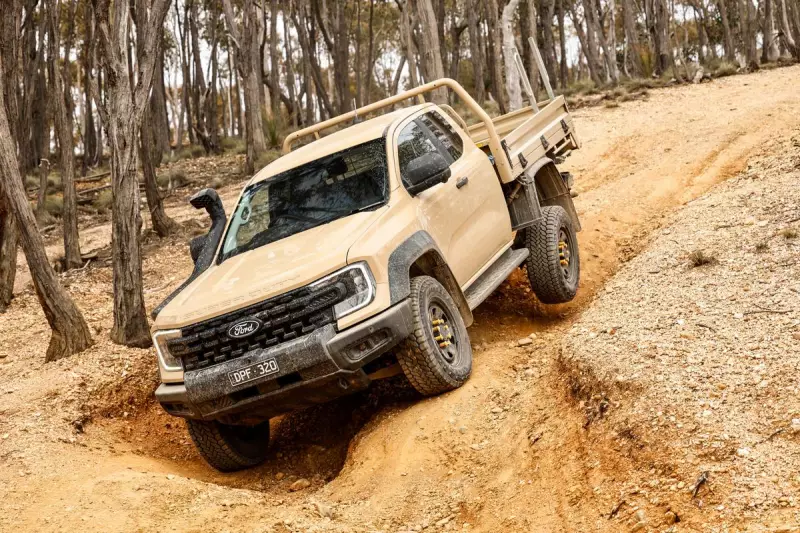
The Ford Ranger Super Duty is poised to become the most Australian-focused utility vehicle since local car manufacturing ceased. Conceived by Ford Australia's chief Andrew Birkic back in 2018, this rugged machine has been entirely designed, engineered, and validated by the local team for global release.
An Australian Vision Brought to Life
The project began when Mr Birkic, then global product marketing lead for Ranger and Everest, collaborated with a senior Ford Truck manager. The vehicle had its global debut in regional Victoria in late 2025. Scheduled to arrive in showrooms from mid-2026, the Ranger Super Duty Pick-Up will be offered exclusively as a dual-cab model in base or XLT specifications.
Pricing is set to start from $93,990 before on-road costs for the dual-cab Pick-Up, climbing to $99,990 for the XLT Pick-Up variant. The dual-cab XLT cab-chassis model will begin at $95,990 before ORCs.

Despite sharing its badge and some styling cues with the standard Ranger, the Super Duty is fundamentally a new vehicle. It was engineered from the ground up to withstand the harsh demands of Australia's remote outback and punishing worksites.
Built Tough: Key Features and Innovations
At its core is a heavily reinforced chassis, complemented by intelligent payload technology and advanced off-road systems. Ford's engineers subjected it to one of the most extreme testing regimes in the company's history to ensure durability.
Significant upgrades include a more robust transfer case, a retuned transmission, and an engine with enhanced cooling. Practical additions feature a massive 130-litre fuel tank and 4mm-thick steel underbody armour. Engineers state this armour can support the vehicle's entire weight if it becomes perched on a rock during off-roading.
The ute also borrows smart tech from Ford's F-Series, including integrated weight scales to prevent overloading. Under the bonnet, the 3.0-litre V6 turbo diesel engine meets stringent EU6.2 emissions standards.
Technical Specifications and Capability
Key specifications that set the Super Duty apart include:
- Increased water-wading depth of 850mm, which is 50mm more than a standard Ranger.
- Seven selectable drive modes (Normal, Eco, Tow/Haul, Mud/Ruts, Sand, Rock Crawl) to tailor vehicle response.
- A four-wheel-drive system with a heavy-duty two-speed transfer case and upgraded low-range gearing from the F-Series.
- Standard front and rear locking differentials on all models.
- Higher-mounted breathers for the differential, transmission, and fuel system for better protection.
- A comprehensive suite of driver-assist technologies, including a 360-degree camera and blind-spot monitoring with trailer coverage.
The Brutal Testing Regime
Ford Australia's validation process was nothing short of brutal, designed to simulate decades of abuse in a condensed timeframe. At the You Yangs Proving Ground, the ute was driven repeatedly through a special mud course until it was caked with over 600kg of packed mud. This test aimed to choke components and find their breaking points.
Autonomous driving robots were deployed for 24/7 endurance runs on the infamous Silver Creek track, which simulates a rocky riverbed to stress the chassis and suspension to the limit. This technology was originally developed for the F-Series Super Duty in North America.
To prove its water-wading claim, engineers executed 27 consecutive crossings of Victoria's Crooked River, achieving the target 850mm depth. The vehicle also endured corrosion baths, towing dyno tests, and punishing real-world off-road trails.
In an unconventional move, the development team built a light-attack fire truck prototype, loaded to nearly 4500kg GVM. This was used to shadow fleet teams in inaccessible areas. Engineers also spent time on a remote cattle station, performing daily tasks like hauling fencing materials and towing heavy equipment.
The Ford Ranger Super Duty represents a significant milestone for Ford Australia's engineering prowess. It's a vehicle born from local insight and validated against some of the toughest conditions on the planet, ready for its mid-2026 launch.