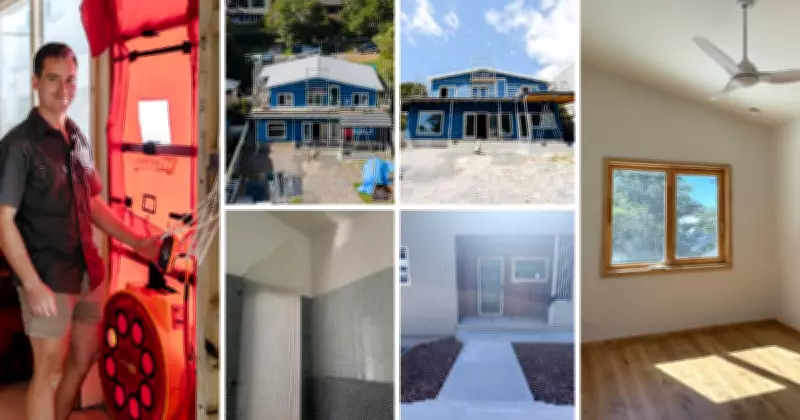
Todd Ackerman, a resident of Wollongong, has embraced a revolutionary approach to home construction with his passive house, designed to deliver unparalleled comfort while minimizing energy consumption. This innovative dwelling, located in the heart of the Illawarra region, stands as a testament to sustainable living and cutting-edge building techniques.
What is a Passive Home?
A passive home is a building standard that focuses on energy efficiency, thermal comfort, and affordability. It achieves this through a combination of high-performance insulation, airtight construction, advanced window technology, and a mechanical ventilation system with heat recovery. The result is a home that requires very little energy for heating and cooling, maintaining a consistent indoor temperature year-round.
Todd Ackerman's Experience
Ackerman, who moved into his passive home in early 2023, has been amazed by the results. 'The comfort is something you have to experience to believe,' he says. 'Even during Wollongong's hot summers, the inside stays cool without air conditioning, and in winter, we barely use the heater. The air quality is also fantastic, thanks to the constant ventilation system.'

The home's design incorporates large north-facing windows to maximize passive solar gain, while overhangs and shading prevent overheating. The building envelope is exceptionally airtight, with triple-glazed windows and thick insulation in the walls, roof, and floor. These features work together to create a stable indoor environment, reducing the need for active heating and cooling systems.
Energy Efficiency and Cost Savings
According to Ackerman, the energy bills for his passive home are a fraction of what he paid in his previous conventional house. 'We've seen a reduction of about 80% in our energy costs,' he reports. 'The upfront cost was higher, but the long-term savings and comfort make it well worth it.' The home also has a small solar panel system that covers most of its electricity needs, further reducing its carbon footprint.
Environmental Benefits
Passive homes significantly reduce greenhouse gas emissions by minimizing energy demand. Ackerman's home produces far less CO2 than a standard dwelling, contributing to a more sustainable future. 'I feel good knowing that my home is not only comfortable but also kind to the planet,' he adds.
Challenges and Adoption
Despite the benefits, passive home construction faces challenges in Australia, including higher initial costs and a lack of awareness among builders and homeowners. However, Ackerman believes that as energy prices rise and climate concerns grow, more people will consider this approach. 'It's an investment in your comfort and the environment,' he says. 'I encourage anyone building a new home to look into passive design.'
The Wollongong passive home serves as a model for sustainable living, demonstrating that it is possible to create comfortable, energy-efficient homes that are both affordable and environmentally responsible. As Todd Ackerman puts it, 'The unseen comfort is real, and it's the future of housing.'