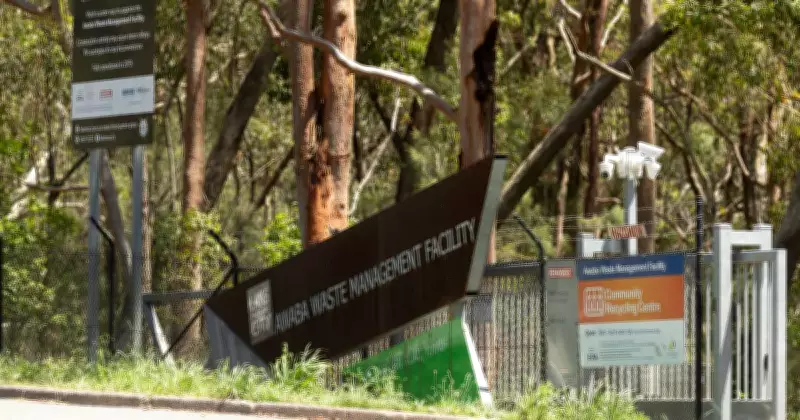
The NSW Environment Protection Authority (EPA) has expressed confidence that pollution from a long-standing leachate leak at the Awaba Waste Management Facility in Lake Macquarie remains contained on-site, despite groundwater monitoring revealing alarmingly high ammonia levels persisting for at least nine years. This ongoing environmental issue has raised significant concerns about potential harm to local waterways and marine ecosystems.
Persistent Non-Compliance and Regulatory Oversight
Multiple independent environmental audits conducted since 2017 have consistently identified non-compliance issues with the leachate pond at the council-operated Awaba Waste Management Facility. The most recent audit, prepared by Integrated Environmental Management Australia and published in December 2024, explicitly declared the site non-compliant due to "leachate bleed into the groundwater" and noted this relates to "potential harm to the environment."
Lake Macquarie City Council has previously received a warning letter from the NSW Department of Planning and Environment for "failing to manage leachate generated by the project." The council's own Soil, Water and Leachate Management Plan 2025 Update, approved by the Department of Planning, Housing and Infrastructure in October 2025, confirmed the leachate leak was ongoing, stating that "groundwater monitoring results have consistently indicated leachate migration to groundwater."

Alarming Ammonia Levels in Groundwater
Testing data reveals disturbing contamination levels in the groundwater surrounding the leachate pond. The leachate pond itself recorded ammonia concentrations ranging from 371 to 1,150 milligrams per litre during 2025 quarters. While these elevated readings are expected within landfill leachate, the real concern lies in the surrounding groundwater monitoring points.
Groundwater testing site MP22, located adjacent to the leachate pond, recorded ammonia readings between 1,030mg/L and 1,470mg/L throughout 2025. Sites MP3 and MP4, positioned south of the leachate pond, showed ammonia levels ranging from 4.26mg/L to 13mg/L. These figures dramatically exceed the Australian and New Zealand Guidelines for Fresh & Marine Water Quality protection level of 0.9mg/L for ammonia, which is toxic to marine life.
Surface Water Monitoring and Contested Findings
Surface water testing presents a more complex picture. Monitoring point MP12, located upstream on the western edge of the facility, recorded minimal ammonia levels between 0.01mg/L and 0.04mg/L in 2025. However, MP15, situated in the south-eastern corner near an unnamed watercourse and measuring water exiting the tip, showed ammonia concentrations ranging from 1.99mg/L to 3.59mg/L – nearly four times above recommended guidelines.
The EPA's assertion that leachate has not migrated off-site has faced scrutiny following the removal of surface water testing point MP8 from the facility's Environment Protection Licence in 2024. MP8, previously positioned on the south-eastern boundary to measure water exiting the tip, recorded quarterly ammonia readings between 2.46mg/L and 2.54mg/L in 2022.
A council spokesperson stated that "MP8 was removed after investigations confirmed the water at that point was not influenced by the AWMF," while the EPA explained that MP8 and MP9 were replaced with four new monitoring points to better understand background surface water conditions and their impact on leachate.
Regulatory Response and Remediation Efforts
An EPA spokesperson acknowledged ongoing engagement with Lake Macquarie City Council since 2017, when the council first reported a small tear in the lining of a leachate dam. The spokesperson emphasized that "off-site monitoring in place since 2017 shows no leachate-affected groundwater outside the landfill's boundary," but noted that recent data provided by the council in December showed elevated levels of various contaminants, including ammonia, in surface water at one monitoring station.
The EPA confirmed plans to meet with council representatives to discuss "further monitoring and next steps." A council spokesperson indicated that remediation work is underway, stating: "Council has implemented engineering solutions, including extraction wells, and continues to work with the EPA to address elevated readings."

In December 2025, the council awarded the tender for the Awaba Waste Management Facility expansion to civil construction company Daracon Group, with an upgrade of the problematic leachate pond forming part of the planned works. This development suggests ongoing efforts to address the facility's environmental challenges while expanding its operations.