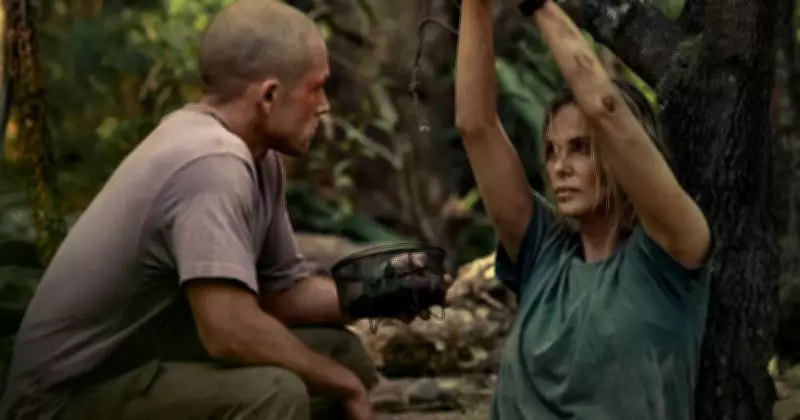
Netflix's latest series, Apex, has sparked widespread discussion for what many are calling the most convincing Australian accent ever attempted by a non-Australian actor in a major production. The show, which debuted last week, has quickly become a talking point among linguists and viewers alike.
A Breakthrough in Accent Authenticity
For decades, Hollywood has struggled to replicate the nuances of the Australian accent, often resulting in performances that range from passable to cringe-worthy. However, Apex appears to have broken this trend. The lead actor, whose identity has been kept under wraps, delivers lines with a level of authenticity that has surprised even Australian audiences.
Dr. Emily Carter, a linguistics professor at the University of Sydney, noted, "The accent in Apex is remarkably close to the standard Australian dialect. The actor has managed to capture the subtle vowel shifts and intonation patterns that are notoriously difficult for non-native speakers."

Why Australian Accents Are Tricky
The Australian accent is characterized by its unique vowel sounds, such as the 'i' in 'like' sounding more like 'oi', and the 'a' in 'dance' being pronounced as a long 'ah'. Additionally, the rhythm of Australian speech is distinct, often rising at the end of sentences, a feature known as the 'Australian Question Intonation'.
Many previous attempts by international actors have fallen short. For instance, Meryl Streep's accent in Evil Angels (1988) was criticized for being inconsistent, while more recent efforts in films like The Great Gatsby and Mad Max: Fury Road have received mixed reviews.
Expert Analysis
Dr. Carter added, "What sets Apex apart is the actor's ability to maintain the accent consistently throughout the series, even during emotionally charged scenes. This level of control is rare and suggests extensive coaching and practice."
The show's dialect coach, Sarah Thompson, revealed in an interview that the actor underwent six months of intensive training, including immersion in Australian media and conversations with native speakers. "We focused on the subtle differences between regional accents, but aimed for a neutral Australian sound that would be understood globally," Thompson explained.
Audience Reaction
Social media has been abuzz with praise for the accent. One Twitter user wrote, "I had to check if the actor was actually Australian. This is the best accent I've heard from a non-Aussie." Another commented, "Finally, a Hollywood production that doesn't make us sound like caricatures."
However, some viewers have pointed out minor inconsistencies. "In episode three, there was a slight slip where the accent sounded more New Zealand," said one critic. But overall, the reception has been overwhelmingly positive.
Implications for Future Productions
The success of Apex could set a new standard for accent accuracy in Hollywood. With growing demand for authentic representation, studios may invest more in dialect coaching and cultural consultation. This could also open doors for Australian actors who often lose roles to international stars attempting local accents.
As streaming platforms continue to produce content for global audiences, the ability to accurately portray diverse voices becomes increasingly important. Apex may be a turning point in how Hollywood approaches accents, proving that with dedication and expert guidance, even the most challenging dialects can be mastered.
For now, viewers can enjoy Apex on Netflix and judge for themselves whether this is indeed the best Australian accent ever attempted on screen.