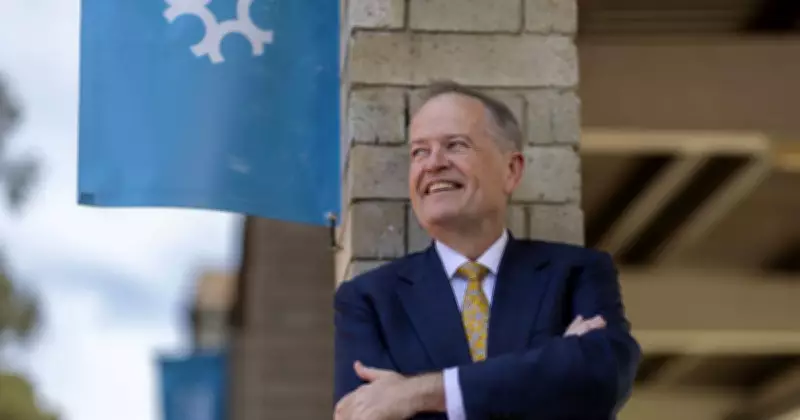
Bill Shorten's First Year at University of Canberra: A Turnaround Story
After completing his first year as vice-chancellor of the University of Canberra, former Labor leader Bill Shorten has reflected on the institution's progress while acknowledging ongoing challenges facing Australia's higher education sector.
Financial Recovery and Enrollment Growth
The University of Canberra is projected to record a significant financial improvement for 2025, with an expected deficit of $3.6 million compared to the previous year's $41 million shortfall. This positive trend coincides with an 11 percent increase in domestic undergraduate enrollments, marking the strongest acceptance figures since the COVID-19 pandemic began.
"I certainly don't feel the need to imitate the elitist universities," Mr Shorten stated, emphasizing his focus on practical education pathways. "The people I'm interested in are the school leavers who want to get a job. I'm interested in adults who might have thought that university wasn't for them."

Sector Challenges and Public Perception
Mr Shorten, who transitioned from federal politics to higher education leadership, warned that universities must work harder to demonstrate their value to Australian society. Drawing parallels between political campaigning and educational advocacy, he noted: "It doesn't matter what result you got in your last election, you're only as good as your next fight, your next issue."
The vice-chancellor highlighted the importance of engaging with critics constructively: "You can write off your critics as uninformed or politically motivated or silly or with agendas. But it's a bit like the voters. You've got to win people over. You can't just talk to your own support base."
Innovative Partnerships and Educational Pathways
During his first year, Mr Shorten has championed several initiatives designed to make higher education more accessible:
- A nation-leading partnership with Canberra Institute of Technology guaranteeing direct entry into seven University of Canberra degrees
- An accelerated pathway to a business degree through collaboration with McDonald's
- Development of stackable credentials and micro-qualifications for working professionals
- Recognition of veterans' Defence service for accelerated degree completion
"We must continue to build a system of stackable credentials and accredited units," Mr Shorten explained. "This is not about devaluing a full university education; it is about creating multiple, flexible entry pathways and exit points to achieve it."
Addressing Artificial Intelligence in Education
With artificial intelligence transforming workplaces globally, Mr Shorten emphasized universities' role in preparing students for technological change. "We're going to be rolling out AI across a range of our courses. It's a non-negotiable," he stated, while cautioning against over-reliance on the technology.
Comparing AI to Prometheus stealing fire in Greek mythology, Mr Shorten noted: "AI is a bit like fire. It can work for you or against you. So really what we've got to do is teach people how to use it. Its benefits are amazing, but an over-reliance on it or a misuse of it is perilous."
Campus Culture and Future Vision
The University of Canberra's 2,500 student accommodation places are nearly full this year, reflecting growing demand. Mr Shorten expressed his ambition to create a vibrant campus environment operating throughout the year, not just during academic semesters.
"I want UC to be a place where it's got the vibe, where people feel welcome, they feel wanted, and they're interested," he said. "I want this place to be fun."
Reflecting on his transition from politics to education leadership, Mr Shorten observed: "I think there's a view out in the public that politicians are unemployable swill, which is, of course, very unfair. So I'm happy, on behalf of my former colleagues, to try and help redefine this sense that politicians are only good at politics."

Despite the challenges of his first year, which included nearly 200 staff departures following job cuts announced before his appointment, Mr Shorten remains optimistic about the university's direction. "I think even the hardened sceptics are saying, OK, there's more good news than bad news coming out of the joint," he concluded.