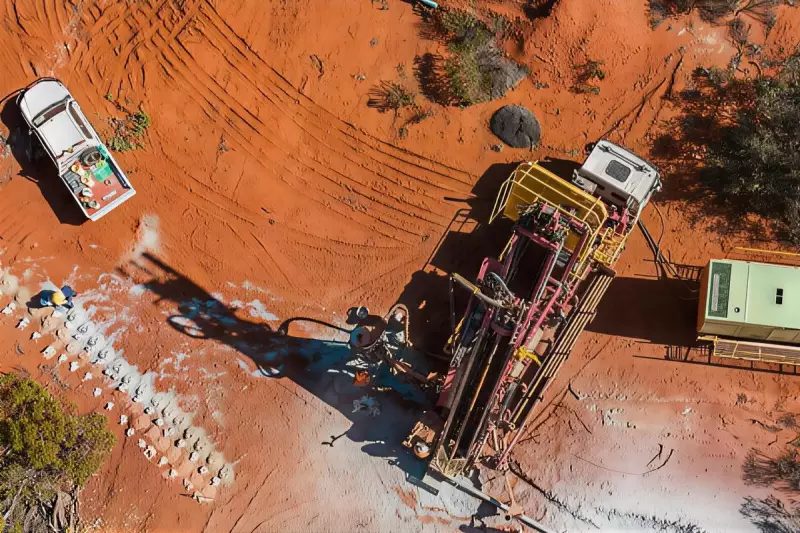
Kalgoorlie Gold Mining (KalGold) has delivered a powerful reminder that size is crucial in gold exploration, announcing drilling results that have dramatically expanded the known mineralised strike at its Pinjin project in Western Australia's prolific eastern Goldfields.
A Rapidly Expanding Gold System
The company's latest reverse circulation (RC) drilling campaign at the Lighthorse prospect has successfully extended the primary gold mineralisation's strike length to an impressive 1.1 kilometres, nearly double its previous known extent. This work is quickly outlining a substantial shear-hosted gold system originating from depth, which remains open for further expansion to the north.
Notable drill intersections from the program include a 15-metre section grading 1.14 grams per tonne (g/t) gold from 84 metres down-hole, with an 11-metre portion of that hitting a higher grade of 1.51 g/t gold. Another broad, 35-metre intersection returned 0.33 g/t gold from 90 metres, including a 9-metre slice at 0.76 g/t gold from 92 metres within a wider 35-metre zone of 0.42 g/t gold.

Connecting the Dots from Surface to Depth
A critical finding from the recent work is that the RC drilling appears to have successfully linked a previously identified, broad near-surface gold anomaly directly to a primary source at depth. This answers a key question that emerged earlier in the year.
In early 2025, aircore drilling ignited investor interest, sending KalGold's share price soaring 500% after uncovering a 1.6-kilometre-long gold-in-soil anomaly, supported by standout hits like 8 metres at 9.21 g/t gold. The big uncertainty was whether this gold was merely transported material or indicated a more substantial source below. The new results firmly point to the latter.
The drilling intersected thick zones of gold mineralisation in fresh rock, closely associated with extensive shearing, alteration, sulphide development, and quartz veining. These are all classic indicators of a genuine orogenic gold system.
Geophysical Correlations and Regional Credibility
Adding further weight to the discovery, the company identified a strong correlation between the gold mineralisation and a pronounced conductivity ridge detected through Sub-Audio Magnetic (SAM) surveying. The most consistent and thickest gold zones align neatly with this geophysical feature, which continues north beyond the current drilling limits.
The broader Pinjin project area continues to show promise. Additional RC drilling at the nearby Wessex and Providence South sites also intersected primary gold mineralisation. Meanwhile, a diamond drill rig is now active at the Kirgella Gift and Providence prospects, with assay results pending.
KalGold is building a compelling land position along the southern end of the Laverton Tectonic Zone, one of WA's most productive gold corridors, home to multiple multi-million-ounce deposits. The project's location is highly prospective, sitting just along strike from Ramelius Resources' 1.1-million-ounce Rebecca gold project, which adds considerable regional credibility to the exploration model.
With infill and step-out RC drilling already scheduled for early 2026, and plans for deeper holes to test the system's vertical extent, the Lighthorse discovery is rapidly evolving from a promising find into a legitimate, large-scale gold target.