The Australian economy is increasingly being propped up by a sprawling network of government subsidies, with close to $100 billion in taxpayer capital now funnelled through opaque off-budget vehicles, according to a sharp critique from finance experts. This shift marks a fundamental change in national governance, moving from reform to reliance on financial support to mask policy failures.
The Rise of the Subsidy State
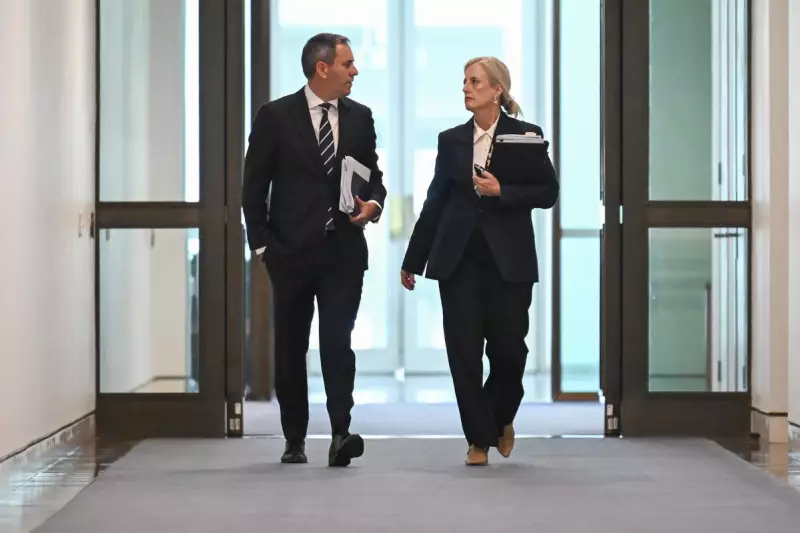
Following the Mid-Year Economic and Fiscal Outlook (MYEFO), Treasurer Jim Chalmers and Finance Minister Katy Gallagher are facing a fragile budget landscape. Critics argue this economic deterioration is not accidental but stems from a new governing principle: when a policy causes pain, the response is not to fix it, but to subsidise it.
The pattern is clear across sectors. Soaring energy bills trigger rebates. A weakening manufacturing sector sees production subsidies introduced. Stagnant wages are met with wage subsidies. When childcare becomes unaffordable, the solution is expanded, unmeans-tested rebates. The core issue, experts contend, is that failed policies are rarely unwound. Instead, they are buried under layers of taxpayer-funded financial plaster.

The Accounting Mirage of Specialist Investment Vehicles
With the federal budget under strain, the government has turned to an accounting contrivance to maintain the appearance of fiscal health: Specialist Investment Vehicles (SIVs). These entities allow the Commonwealth to deploy vast sums of borrowed money while keeping the associated debt and costs off the official budget.
Currently, eight SIVs control approximately $100 billion in public funds. The Department of Finance describes them as entities that "prudently invest public funds across diverse sectors." However, recent examples of this so-called prudence include a $45 million loan to bail out the US private-equity owners of Arnott's Biscuits and a $35 million loan to Patties Food Group, meaning Australians are now invested in the nation's biscuit and pie production.
The crucial accounting fiction is the claim that SIVs generate "commercial returns," which allows them to be classified as investments rather than subsidies. However, required rates of return are being quietly lowered, increasing the risk that the auditor-general or ratings agencies will force an admission of fiscal reality. With the Commonwealth's borrowing cost near 5 per cent, taxpayers are liable for roughly $5 billion a year in interest alone, before any administrative costs.
Distorted Markets and a Camouflaged Economy
The economic cost of this system extends beyond accounting tricks. SIVs and similar vehicles crowd out private investment, distort capital allocation, and suppress productivity growth. They conscript the public into government-run leveraged investment schemes, socialising losses while privatising rewards for politically favoured projects.
This approach is spreading. The Future Fund has begun investing in renewable energy, placing it in direct competition with other government-backed entities like the Clean Energy Finance Corporation, the National Reconstruction Fund, and the Australian Renewable Energy Agency. The result is a bizarre distortion: multiple debt-financed government agencies compete for funding from another pool of government subsidies.
Australia is drifting towards a model where the state disguises policy failures with opaque financial structures and politicised capital allocation. This is not reform; it is camouflage. Until governments find the courage to unwind bad policies rather than conceal them, the subsidy state will keep growing, the private sector will shrink, and taxpayers will foot the bill for an economic illusion.
The lesson from corporate history is stark. Enron executives were imprisoned for using similar off-balance-sheet vehicles to hide the company's true financial state. While Canberra's architects face no such reckoning, the principle remains: accounting complexity delays scrutiny but does not prevent it. When these structures eventually falter, the cost will be borne not by their creators, but by the shareholders—in this case, the Australian taxpayer.