The Untold History of WA's Gold Rush Woodlines
The discovery of gold transformed Western Australia almost overnight, shifting it from a small agricultural economy to a booming colony. While early finds in the Kimberley in the late 1880s hinted at potential, it was the significant alluvial gold deposits uncovered in Coolgardie in 1892 and Kalgoorlie in 1893 that triggered a massive influx of fortune seekers. This surge saw the population explode from approximately 48,000 to 180,000 within just a decade, flooding government coffers with revenue from licenses, fees, and taxes that funded major public works.
The Critical Need for Firewood and Timber
As alluvial gold became scarce by the late 1890s, deep mining operations took over, creating an urgent demand for firewood and timber. According to Phil Bianchi, author of Woodlines Of Western Australia, these resources were essential for steam-powered machinery, mine supports, and powering facilities like the Kalgoorlie power station, hospital, and water condensers. Before the Goldfields Water Supply pipeline arrived in 1903, water condensers alone consumed vast quantities of firewood, with one plant in Coolgardie burning 100 tons daily to produce 455,000 liters of fresh water.
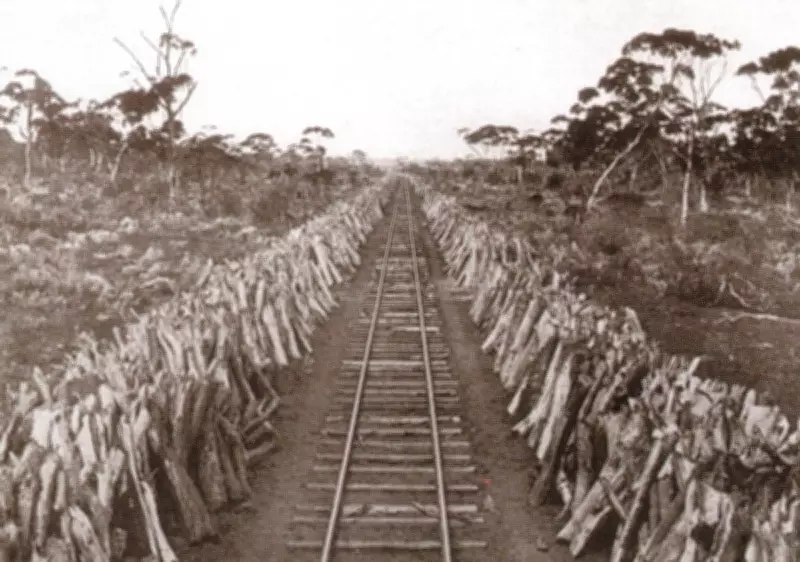
The Heritage Council notes that as the population rapidly increased, local wood stocks around Kalgoorlie were quickly depleted, forcing woodcutters to venture further afield. This led to the development of an extensive network of railway lines, known as woodlines, which transported wood over vast distances to Coolgardie and Kalgoorlie.

The Elaborate System of Woodline Railways
Firewood supply companies constructed an intricate system of rail lines, cutting systematically through the bush. They established main rail lines with spur lines branching off, setting up main camps at the end of each line for workers including cutters, carters, and loaders. When an area was cleared, spur lines were relocated, and workers' camps moved accordingly. Companies obtained permits from the WA Forests Department, required to cut all trees except those under three inches in diameter or exceptionally large, old trees. In addition to firewood, large trees provided timber for sleepers, mining supports, and construction.
By 1900, mines in Kalgoorlie and Boulder were using 1,200 tons of firewood and mining timber daily. Larger operations, such as the Kurrawang company in 1907, featured seven locomotives, 200 firewood wagons, 16 traveling water tanks, 104 horses, and 96 drays, laying about 100 kilometers of lines annually. In November 1908, Kurrawang employed 674 workers, including 263 Britishers, 234 Italians, 158 Slavic migrants, and 19 others, highlighting the diverse labor force.
Life and Labor on the Woodlines
Main camps often included stores, schools, and police stations housed in old rail carriages, with smaller outlying camps set up further out. Workers, predominantly Italian or Slavic migrants, endured harsh conditions, living in tents or hessian-walled shacks with corrugated iron roofs and earthen floors—unbearably hot in summer and freezing in winter. Supplies were delivered via trains returning with empty trucks, and costs were deducted from wages. Illicit grog sellers exploited paydays, charging exorbitant prices, sometimes bribing local police with goods like eggs or chicken to overlook their operations.
Migrants maintained their cultural traditions, observing Sundays and religious feast days, bringing spaghetti, wine, and accordions to the bush. However, they faced significant racism, accused of taking jobs from Britishers and living frugally, leading to riots in Kalgoorlie in 1919 and 1934. Press coverage was often derogatory, though not always; in 1907, The Sun noted that foreigners were essential for profitable woodline operations, as Britishers were less willing to tackle the vigorous work of woodcutting and loading.

Challenges and Legacy of the Woodline Industry
During World Wars I and II, some woodline workers were interned as citizens of enemy nations, straining wood supply. Frequent disputes over pay and conditions resulted in 19 major strikes between 1905 and 1944. Despite the tough conditions, migrants found better prospects than in Europe, working hard to save money for bringing families to Australia or returning home to marry. Women faced isolation and harsh living conditions, managing households, gardens, and childcare while adapting to a new language.
Schools on the woodlines catered mostly to migrant children, who quickly learned English and helped their parents integrate. The Sun praised woodcutters as "modern Hercules," highlighting the healthy, manly life of the bush. The scale of operations was massive, with clear-felling across 3.04 million hectares and 21.6 million tons of firewood and timber delivered between 1900 and 1964, before the industry declined due to rising costs and a shift to coal and oil-based fuels.
Bianchi emphasizes that the woodline industry left a lasting legacy of settled families, with many migrants establishing farms near Southern Cross or market gardens, vineyards, and orchards near Perth. Their descendants now contribute to Australia's successful multicultural society, a testament to the hard work and perseverance that defined this forgotten chapter of WA's history.