Inside Trump's Oval Office: A 2026 Interview Showcases Grievances and Grand Plans
Trump's Oval Office Interview: Grievances and Grand Plans

In a revealing and wide-ranging encounter, President Donald Trump hosted New York Times journalists in the Oval Office on Wednesday, January 7, 2026, showcasing a blend of personal grievance, domestic renovation pride, and a deliberate projection of indefatigable energy.

The Many Faces of a President

Over nearly two hours, followed by a tour of the official residence, Trump cycled through the personas that have defined his public life. He was at once the gracious host, summoning valets for water and Diet Coke, and the father figure, referring to Vice President JD Vance, 41, and Secretary of State Marco Rubio, 54, as "kids." Both men, notably, wore shoes gifted by the president.

He frequently revisited his identity as a builder from Queens, obsessed with turning the White House into a showcase property. "I was really good at real estate," Trump mused. "Maybe I was better at real estate than I am at politics." This theme underpinned much of the evening, as discussions about external chaos often circled back to his physical upgrades of the presidential home.

Stamina and Health Under Scrutiny

A central aim for Trump was to counter narratives about his age and health, particularly from media outlets he has accused of sedition for such reporting. The president, who turns 80 in June, insisted he feels physically the same as he did four decades ago.

He revealed he takes a 325-milligram daily dose of aspirin to keep his blood "nice and thin," despite medical guidance advising against its routine use for stroke prevention in people over 70. He stated he has never had a heart attack and avoids other blood thinners, claiming, "everyone I know that took them is dead." He also denied using GLP-1 weight-loss medications, though quipped, "I probably should."

His energy, he suggested, far surpassed that of his 83-year-old predecessor. "I think Joe Biden is the worst thing that ever happened to old people," Trump said, returning repeatedly to comparisons with the former president.

A Catalogue of Grievances and a Call from Colombia

Trump's deep-seated sense of injustice was palpable. He listed those he felt had disrespected him: the news media, the Norwegian Nobel Committee, New York City Mayor Zohran Mamdani, and officials from both parties. "I've ended eight wars and didn't get the Nobel Peace Prize," he complained. "Obama got it. He was there for a few weeks, and he got it."

The interview was punctuated by the duties of office. An aide handed him a note reading, "Colombian President Gustavo Petro is calling for you," prompting a hush in the room. Days prior, Trump had toyed with attacking Colombia, accusing Petro of being "a sick man who likes making cocaine and selling it to the United States." After the hour-long call, Trump dictated a conciliatory Truth Social post to his aide, Natalie Harp.

He later circled back, seeking validation: "Do you think Biden could do that?"

The 'Upgrader' and His Legacy in Stone and Glass

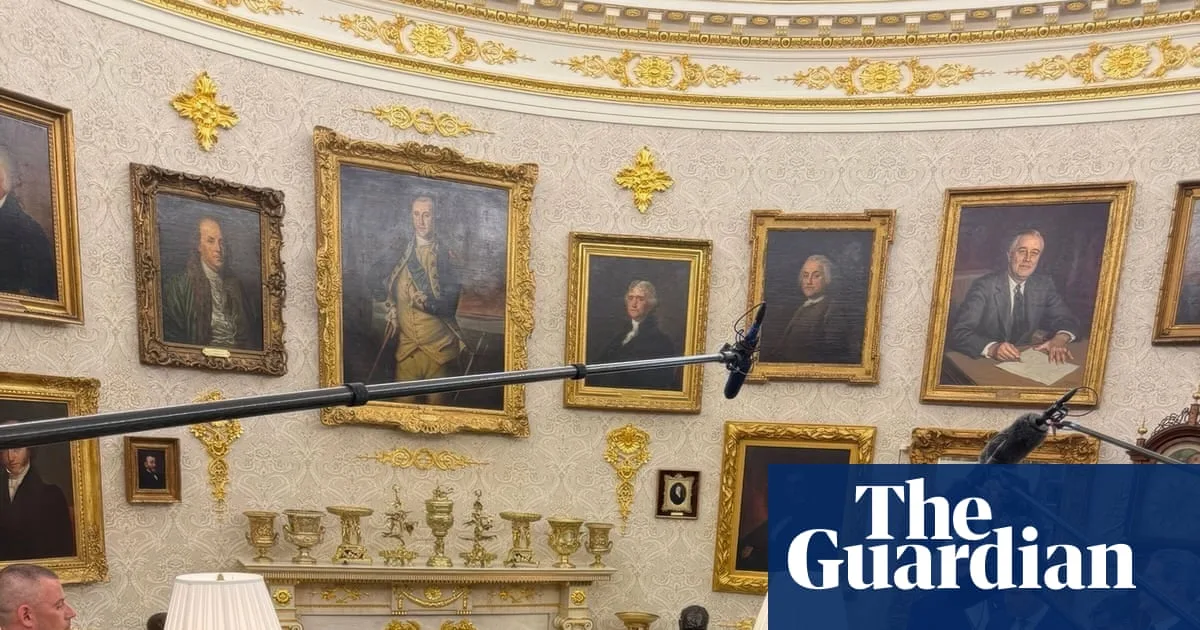
Trump's foremost passion was displaying his renovations. He gleefully pointed out the marble flooring in the Palm Room, where the veins aligned perfectly, and the politicised array of presidential portraits in the colonnade.

His pièce de résistance, however, was a $400 million ballroom project under construction where the East Wing once stood. Funded by donations and his own money, he described a structure with 4-to-5-inch-thick bulletproof glass, large enough for future inaugurations. As workers toiled outside under floodlights, Trump peered at a detailed miniature model, carefully positioning a tiny Treasury building.

"I upgrade everything. I'm an upgrader," Trump declared, his builder's pride overriding even a question about elections in Venezuela. "I'm a big fan of democracy," he said, before pausing. "Let me show you this before I talk about democracy."

The encounter concluded with Trump signing personnel orders with his signature Sharpie, but not before one final prediction about his ballroom. "They'll be thanking me," he said, gazing at the model of the world he is rebuilding to his own specifications.