At first glance, Bishop's Waltham appears as just another picturesque stop on the route from historic Winchester to the naval docks of Portsmouth. Yet beneath its charming facade of Georgian houses and blooming flower boxes lies a remarkably turbulent history, positioning this Hampshire settlement at a dramatic crossroads of English conflict for millennia.
From Stone Age Flints to Norman Conquests
The town's story begins not with kings or admirals, but with the retreat of the ice. As the last Ice Age thawed, Mesolithic hunter-gatherers returned to the area. Evidence of their presence emerged in 1967, when an excavation beneath a supermarket car park uncovered 93 worked flint tools. These nomadic peoples eventually settled, clearing forests to farm early forms of wheat and barley.
Successive waves of technological and social change followed. Bronze gave way to iron, particularly for tools and weapons, prompting communities to build protective hill forts. This localised existence was irrevocably shattered by the arrival of the Romans. While Julius Caesar's incursions came in 55BC and 54BC, the full-scale invasion under Emperor Claudius in 43AD saw four legions—around 40,000 men—march into Britain. The main Roman road between Winchester and Chichester passed nearby, and villas were established in Waltham.

With the Roman Empire's collapse after 400AD, the area faced new raiders: Picts, Irish, and Scots. It was then settled by Saxons, Angles, and Jutes. Bishop's Waltham was an early Saxon settlement, a fact underscored by the discovery of a Saxon font in a town garden during the 1930s, now housed in St Peter's Church. The name 'Waltham', meaning 'woodland domain', was common, with twelve such settlements recorded in England by 550AD.
Royal Estates, Viking Raids, and a Bishop's Palace
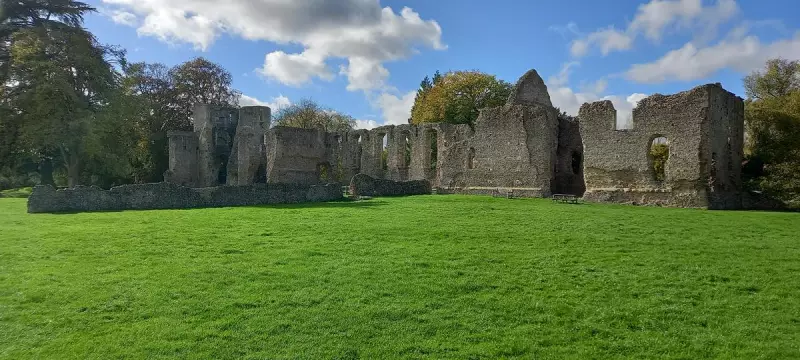
Waltham's significance grew as it became a royal estate of the Kings of Wessex. Its destiny changed in 908 when King Edward the Elder exchanged it with the Bishop of Winchester for lands at Portchester Castle. This transaction gave the town its enduring prefix: Bishop's Waltham. The grand Bishop's Palace, whose ruins remain the town's centrepiece today, was constructed and became a frequent royal stopover; an astonishing 17 out of 21 English monarchs who ruled between 1100 and 1600 are recorded as visiting.
Peace, however, was fleeting. A Viking fleet returned in 1001, burning Waltham and the surrounding region. This was merely a prelude to 1066, when Norman soldiers marched through, plundering livestock and grain and setting fires. The town is recorded in the Domesday Book (1085) as having a park 'for wild animals', one of only 35 in England at the time. The bubonic plague, or Black Death, arrived in 1348, devastating the population and killing two-thirds of the town's inhabitants in a single year.
Civil War Destruction and a Disgraced Admiral's Final Walk
The 17th century brought a domestic conflict that scarred the town anew. During the English Civil War, Parliamentary troops under Cromwell looted and set fire to the Bishop's Palace in 1644, destroying the economic heart of the community. The scale of the surviving ruins hints at the grandeur that was lost to Cromwell's cannons and flames.
Centuries later, Bishop's Waltham played host to a very different historical figure. In 1805, Pierre-Charles-Jean-Baptiste-Silvestre de Villeneuve, the defeated French admiral from the Battle of Trafalgar, was billeted in the town on his own recognisance. He was spared the grim fate of 7,000 French prisoners held at nearby Portchester Castle. Villeneuve was even permitted the courtesy of attending the funeral of his victorious adversary, Lord Nelson.
He reportedly took contemplative strolls through the town's lanes after breakfast at the Crown Inn, perhaps dwelling on the poor decisions that led to his fleet's crushing defeat, which ultimately ended Napoleon's plans to invade England. His return to France in 1806 was followed by a mysterious and brutal death: he was found stabbed six times, five wounds to the heart. An official verdict of suicide was returned, but many historians believe it was an assassination ordered by Napoleon as revenge for the catastrophic loss at Trafalgar.

Scars and Survival at the Crossroads
Today, Bishop's Waltham embodies the layered history of England itself. Its gentle pace, variety of cafes, and characteristic brick architecture—a legacy of its century-long role as a brick manufacturer—speak of adaptation. Yet just beneath the surface lies a narrative of successive invasions, royal favour, plague, and war. While many of Britain's grand city landmarks were scarred by World War II bombing, small towns like Bishop's Waltham survived largely intact, preserving these 'little jewels' of the nation's tumultuous past. The town stands not just as a quiet haven, but as a living museum at the crossroads of history, where every stone has a story to tell.