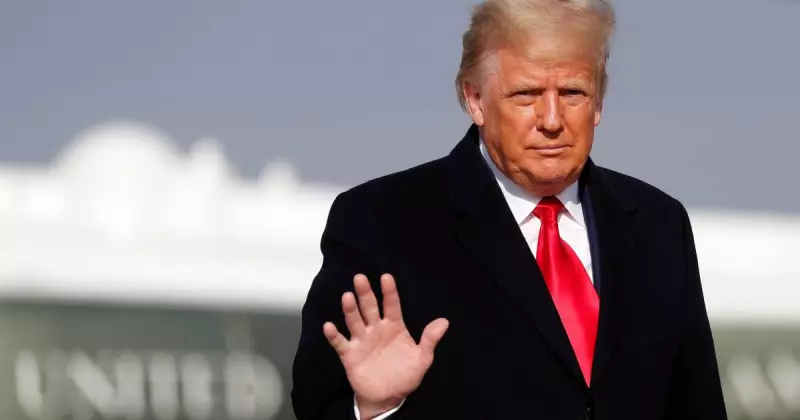
The fate of Ukraine, and arguably the broader security of Europe, may have been shaped this week during a high-stakes meeting at Donald Trump's 'Winter White House' in Florida. The encounter between the incoming US President and Ukraine's Volodymyr Zelenskyy was smoother than their first awkward 2025 Oval Office meeting, but underlying tensions reveal a perilous diplomatic landscape.
A Dangerous Credulity Towards Putin
The talks were overshadowed by a fresh point of friction: Moscow's claim that Ukrainian forces launched a swarmed drone attack on Vladimir Putin's luxury holiday residence. US national security officials and the CIA have stated there is no evidence this event occurred, suggesting it is a fabrication by the Kremlin designed to sour Washington's relations with Kyiv.
Despite this, reports indicate Trump was "very angry" about the alleged attempt and is taking Putin's word over his own intelligence agencies. When challenged on the attack's veracity, Trump's reported response was telling: "President Putin told me this morning it did." This readiness to accept the Russian leader's narrative uncritically presents a profound danger to the Western alliance.

Zelenskyy's Survival Strategy: The Art of the Deal
For President Zelenskyy, the meeting was a critical exercise in survival diplomacy. With 800,000 active Ukrainian troops now forming the largest army in Europe outside of Russia itself, the military reality has shifted. However, this formidable force remains entirely dependent on continued flows of Western military supplies and intelligence support.
To secure this lifeline, Zelenskyy must remain in Trump's good graces. This necessitates a delicate balancing act: paying lip service to the former president's unconventional views on the conflict, his apparent fondness for Putin, and his belief in his own unique capacity to broker peace, while simultaneously holding a brutal Russian adversary at bay.
Zelenskyy has learned that playing Trump, rather than being played by him, is an essential skill. A previous breakthrough in an August Oval Office meeting reportedly occurred simply because Trump introduced Zelenskyy to a former Miss Ukraine, an act that "humanised" the leader in Trump's eyes.
The Stark Reality on the Ground
While "peace" talks generate headlines, the situation on the battlefield tells a different story. Russia is actively scaling up its military offensive, with Putin ordering advances into northern Ukraine to expand a "buffer zone" in the Sumy and Kharkiv regions. Russian generals continue their campaign to seize the strategic region of Zaporizhzhia.
This is not the behaviour of a leader seeking a diplomatic off-ramp, but of one consolidating gains. Reports suggest Trump has pressured Ukraine to cede the entire Donbas region, while Putin's unchanged demands include Ukrainian withdrawal from Kherson and Zaporizhzhia—territories Russia does not fully control.
In his New Year address, Zelenskyy claimed a potential deal is "10 per cent" away, stating that "those are the 10 per cent that will determine the fate of peace." Yet that final fraction represents the chasm between sovereignty and capitulation. The fundamental equation remains unchanged: if Russia puts down its guns, there will be peace. If Ukraine puts down its guns, it will cease to exist.
Zelenskyy's immense challenge is to convince a starry-eyed Trump that Putin, not Ukraine, is the obstacle to peace, all while defending his nation's very existence. The outcome of this high-wire act will resonate far beyond the borders of Ukraine.