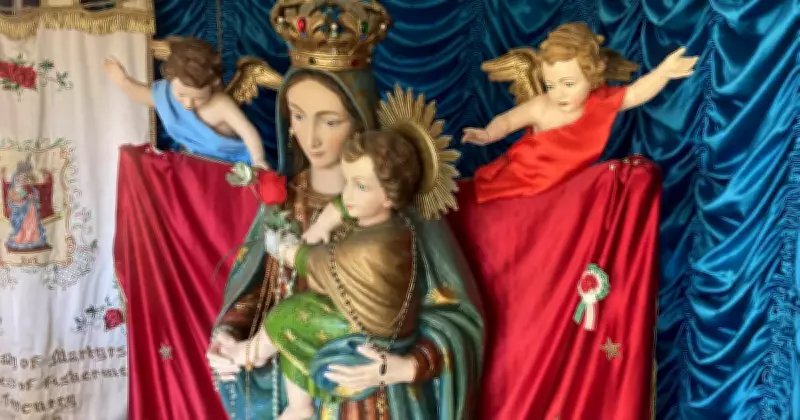
The Tuncurry Madonna: A Symbol of Faith and Fishing Heritage
In the heart of the Mid North Coast, the town of Tuncurry holds a unique piece of maritime and religious history that continues to captivate locals and visitors alike. The Tuncurry Madonna, now proudly displayed at the Great Lakes Historical and Maritime Museum, stands as a testament to the deep-rooted traditions brought by Italian immigrants to this coastal community.
A Surprising Discovery in Tuncurry
Recently, while exploring the backstreets of Tuncurry, one might stumble upon the Madonna de Martiri, resplendent in rich robes and adorned with a jewelled crown. This four-foot statue, imported from Molfetta, Italy, was once the centrepiece of an annual procession that saw fishermen carry it to the waterfront for the blessing of the fleet. The tradition, which began in 1963, involved the entire community, with Italian families from Sydney and Newcastle contributing to its grandeur through hand-embroidered cloaks in nine-carat gold thread.
The Blessing of the Waters and Local Processions
This discovery echoes other religious traditions in the Lower Hunter region, such as the annual Blessing of the Waters ceremony held at Newcastle's Bogey Hole. Here, young swimmers dive into the water to retrieve a crucifix thrown by clergy, a practice that highlights the enduring connection between faith and the sea. Similarly, the Greek Easter Parade in Hamilton, with its bagpipes, candles, and solemn processions, reminds us of the vibrant cultural tapestry woven into Australian life, though such events are becoming rarer in modern times.

Historical Roots and Community Impact
The story of the Tuncurry Madonna dates back centuries to Molfetta, Italy, where legend tells of fishermen recovering a statue from a storm-tossed sea, declaring it their protector. In Tuncurry, Italian fishermen, grateful for new opportunities in Australia, brought this tradition to life, building a grotto and fostering community involvement. The word "Tuncurry" itself, meaning "plenty fish" in Aboriginal language, fittingly underscores the town's fishing heritage.
Since 2018, with the closure of the local Catholic church, the Madonna has found a new home at the museum, preserving memories of a tradition that lasted over 52 years. While crowds have dwindled, the legacy of the blessing of the fleet and similar events across Australia, from Western Australia to Port Pirie, continues to inspire reflection on how immigrant cultures enrich our national identity.