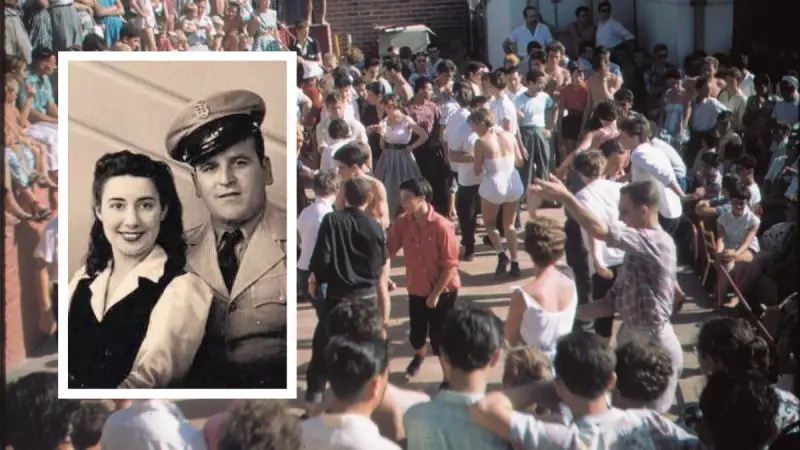
In post-war Perth, a cultural earthquake was rumbling. As the world emerged from the shadows of conflict, a new generation in Western Australia began carving its own identity, loudly and rhythmically rejecting the paths of their parents. The catalyst was American rock'n'roll, and its epicentre was an unassuming beachfront milk bar in Scarborough that would become legendary: the Snake Pit.
The Hay Street Crackdown and the Birth of a Panic
The establishment's alarm bells rang loudly on October 22, 1956. The West Australian reported a police operation under the headline “Police Act Quickly To Quell City Rock-n-Roll Scene.” The disturbance began outside a city theatre, likely showing the film Blackboard Jungle featuring Bill Haley's Rock Around the Clock.
Inside, the audience had “surrendered to the rhythm.” Outside, about three couples began dancing in Hay Street, gathering a clapping crowd. When police moved to break it up, firecrackers were thrown and the mob spilled onto the road, blocking traffic. Nine teenagers were arrested and charged with disorderly behaviour, bundled into vans amidst struggles and thrown fireworks. This event crystallised a growing fear of the new youth movement.

Bodgies, Widgies and the Heart of the Scene
This group of rebellious young Australians, distancing themselves from a pre-war British heritage, became known as bodgies and widgies. As scholar Lorna Baker noted, they were notorious nationwide. Bodgies wore tight pants, cut-away collar shirts, Slim Jim ties, and long jackets with velvet collars. Their female counterparts, widgies, sported big skirts with petticoats or skin-tight pedal pushers.
Their sanctuary was La Spiaggia ('the beachfront') on Manning Street in Scarborough, bought in 1953 by former US marine Don Errichetti and his Italian-born wife, Rosina Rifici. They installed Perth's first jukebox, which initially played Italian and popular post-war music. Rosina's grandfather sent records from South America, including early rock'n'roll.
When a retaining wall was built in the summer of 1955-1956, the resulting sunken space became a dance floor. As historian Adam Trainer wrote, when dancers moved to jiving—the style popularised by rock'n'roll films—the wooden floor resembled a writhing mass, earning the venue its famous nickname: the Snake Pit.
A Cultural Hub Under Siege
The Pit quickly became the live centre of Perth's rock'n'roll culture. Hundreds would catch buses to Scarborough to swim, watch, and dance. Favourites on the jukebox or teens' own records included Jailhouse Rock, Long Tall Sally, and Blueberry Hill, with Elvis Presley reigning as the crowd's favourite.
Rosina Errichetti recalled a vibrant mix: bodgies, a group of “rich kids” who watched but dared not enter, and “well tanned” beachgoers in bathers. Surf lifesaver and policeman Constable Tony Martin even organised Sunday afternoon dance competitions.
Yet, to protective middle-class parents and authorities, the Pit was unsavoury and dangerous. A moral panic was brewing. In 1955, police formed a special anti-bodgie unit. CIB Chief Inspector J.I. Johnston declared war, vowing to seek them out “in the milk bars, in the streets and in their homes,” calling the cult a “breeding place for the worst type of crime.”
By 1958, The Daily News campaigned to clean up the Scarborough beachfront. Rival businesses complained about disruption. Despite Rosina's insistence that trouble was minimal and her husband could handle any aggressors—famously throwing one troublemaker over a wall—the pressure mounted. The Errichettis, swayed by adverse publicity, made the fateful decision to shut down the Snake Pit.
The Legacy of a Lost Era
The closure left a void. Rosina Errichetti lamented that “nothing has ever been able to replace and recapture the same atmosphere that we once created.” Don later expressed regret, stating he shouldn't have been “so easily swayed.” Constable Martin reflected that the crowds were noisy simply “because they were alive,” and “there wasn't any harm in them.”

As Charlie Fox wrote in Radical Perth Militant Fremantle, the Snake Pit was collateral damage in the war on bodgies. It closed, “leaving a hole in the summertime recreation of northern suburbs youth.” Historian Adam Trainer notes that participants later looked back with nostalgia, viewing their actions as largely innocent expressions of a working-class subculture.
The Snake Pit's story is more than a nostalgia trip. It marks the birth of a distinct youth identity in post-war Australia, a fleeting moment where rock'n'roll, fashion, and dance converged on a Scarborough corner, challenging social norms and forever changing Perth's cultural landscape.