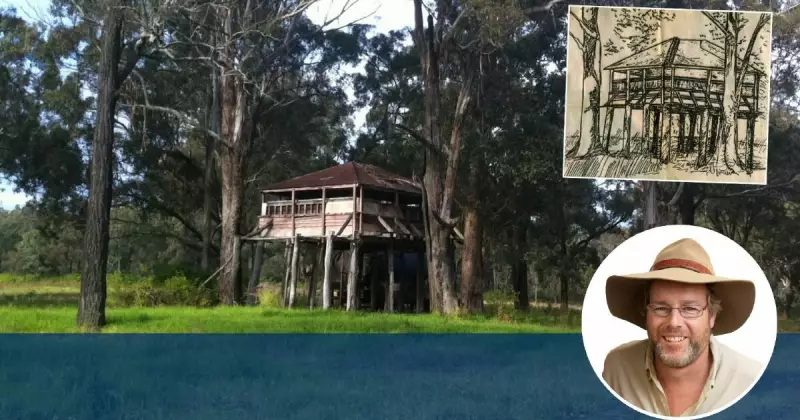
As thousands of holidaymakers travel the Hume Highway towards Sydney each summer, one peculiar sight never fails to spark curiosity. Partially hidden among trees on the eastern side of the motorway near Menangle, a mysterious wooden structure, often mistaken for an elaborate tree house, continues to baffle drivers.
The Enduring Mystery of the Highway 'Tree House'
For over a decade, columnist and mystery investigator Tim the Yowie Man has fielded the same persistent question from readers: what is that strange tower? Theories have ranged from the fanciful – a World War II watchtower, a bandstand, or even a summerhouse for a French winemaker – to the plausible. The answer, revealed in this column fourteen years ago and confirmed today, is surprisingly simple.
It is a tank stand, or water tower, built in the interwar or post-war period to provide gravity-fed water for local agriculture and community dwellings. Known officially as the Menangle Water Tower, this functional piece of infrastructure has become an unlikely roadside icon.

A Future Secured: Heritage Protection on the Horizon
With the relentless expansion of Sydney's south-western suburbs edging closer to the tower's location on private land, concerns for its future have grown. Reader Janine Black of Kambah recently voiced a common fear, asking if the landmark was "in danger of being demolished" after driving past it.
Thankfully, there is good news. An insider at Wollondilly Shire Council has reported that the tower is nominated for protection in the Wollondilly Heritage Planning Proposal, which is in its final stages. The heritage inventory for the proposal directly references Tim the Yowie Man's 2012 exposé on the structure.
The proposal states the tower "is locally significant for its historic and aesthetic values" and, according to the council correspondent, "will be gazetted as a new heritage item next year." While the council cannot force the private owner to actively conserve the tower, this gazettal means it cannot be readily demolished, ensuring its survival as a tangible link to the region's pioneering past.
The Menangle Water Tower is located on the eastern side of the southbound M31 Hume Highway, between the Menangle Bridge over the Nepean River and the first crossing of Moreton Park Road. It remains on private property with no public access, best viewed from the passenger side of a vehicle.
Curious Connections: From Explorers to Stone Farmhouses
In a separate but fascinating historical twist, readers have uncovered links between early colonial expeditions and a notable Canberra figure. Regular correspondent Jeremy Smith of Kaleen points to a connection between the famed 1824-25 Hume and Hovell expedition and businessman William Klensendorlffe.
Klensendorlffe, a German emigrant, once lived in a substantial two-storey stone farmhouse built by convict labour on the banks of the Molonglo River in 1840, behind the present-day Albert Hall. Before that, one of his first enterprises was running the Myrtle Inn near Tahmoor. Explorer William Hovell's journal confirms the expedition party stayed at "Mr. Klendorff's house" on October 4, 1824.
While Klensendorlffe's Canberra farmhouse fell into ruin and was demolished in 1924, his former inn, now known as Tahmoor House, still stands. Meanwhile, researcher Tony Maple of Canberra & Region Heritage Researchers has identified a circa-1920 photo in the National Archives, possibly showing the ruins of the Klensendorlffe stone farmhouse, though it is catalogued as "Duntroon."
Adding to the web of connections, Peter Browning reports that Joseph Kaye, whose family later lived in Klensendorlffe's farmhouse, emigrated to Australia on the same ship, the Sarah, as William Klensendorlffe himself in 1832.
Nature's Wonders: Ant Empires and Collection Techniques
Shifting from history to natural history, reader John Connelly of Wallaroo reports a meat ant nest on his property measuring a staggering 6.8 metres by 2.9 metres, visible on Google Earth. He describes complex ant "empires" with pathways extending up to 100 metres and observed "ant wars" to establish boundaries.

Another reader, Jeffrey Smith of Kambah, inquired about how scientists collect ants for study. Maik Fiedel from Melbourne Museum explained the process for their Bugs Alive! exhibition. To collect diurnal meat ants, researchers agitate a nest, prompting the ants to pour out.
To avoid becoming part of the collection themselves, the team smears a Vaseline barrier on their gumboots—a practical solution reminiscent of the famous 1980s Holeproof Antz Pantz commercials. They then use a low-speed handheld vacuum with a similar Vaseline barrier to safely harvest the insects.
From a protected water tower and intertwined colonial histories to the vast empires of ants, the region continues to offer mysteries, connections, and natural wonders for the curious observer.