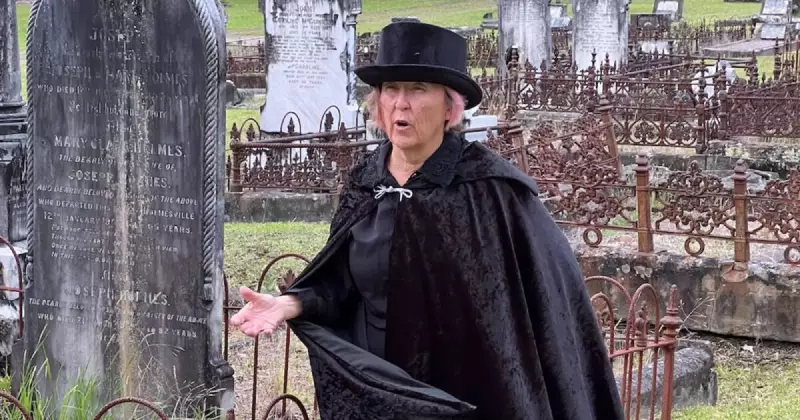
In the shadow of Mount Sugarloaf, a unique performance unfolds among the ageing headstones of one of Lake Macquarie's oldest burial grounds. Professional storyteller Jo Henwood is bringing more than a century of local history back to life for captivated audiences at West Wallsend Cemetery.
A Living History Among the Headstones
Dressed in a black outfit complete with a top hat and a flowing cape reminiscent of a nineteenth-century undertaker, Henwood transforms the serene cemetery into a stage. Her storytelling walks, part of events like the recent History Illuminated Festival, see her move between graves, using a collection of eleven different hats to signify the change from one character's tale to the next.
The West Wallsend Cemetery is one of the region's oldest, with the first recorded burial dating back to February 1890. While a headstone count suggests around 700 burials, deeper scrutiny of records indicates more than 1300 people have been laid to rest there, with a few interments still occurring each year.

The site's history is deeply intertwined with the area's mining past, situated near the paddocks where the vanished township of Ladysmith once thrived. At the industry's peak, nine undertakers operated locally to serve communities where a single major pit employed 355 miners in 1899.
Honouring Stories of Tragedy and Resilience
Henwood's narratives, based on research by local historians, cover a broad spectrum of human experience. She shares tales of young lives lost, dramatic mining accidents, and family tragedies, such as four members of the same family dying within two years.
One particularly poignant story is that of a World War I soldier who survived the horrors of the trenches and the subsequent Spanish Flu pandemic, only to return home to West Wallsend and be killed by a train. Another involves a young child lost in the bush during the 1930s Depression, a story that once prompted an audience member to reveal his father was part of the original search party.
"My storytelling tours are certainly a way of honouring the deceased and their relationship with other people," Henwood explains. "And you can never know what happens during walks." An accredited member of the Storytellers Guild of NSW with 26 years of professional experience, she is now considering expanding her walks to other Lake Macquarie cemeteries and Newcastle, though she firmly draws the line at conducting ghost tours, which she views as disrespectful.
Newcastle's Maritime Collection Declared a National Treasure
In related heritage news, a significant collection of maritime artefacts formerly housed in Newcastle has received a major endorsement. An independent assessment has declared the Newcastle Maritime Museum Society's collection to be of national significance.
Assessor Kevin Jones, engaged by the society after the museum's sudden closure in May 2018, described the 6000-item collection as "very rich indeed" in a new 34-page report. The collection, first established by Harbourmaster Captain Ken Hopper in 1972 and valued at $1 million back in 1981, was Newcastle's first major museum.
Two of its prize exhibits are already on loan to the Newcastle Museum: the Victoria II lifeboat, which served the port for 40 years from 1897, and a rare 19th-century rocket cart used by the Newcastle Rocket Brigade. The collection is also deemed highly significant for its record of the Hunter's major shipbuilding history at the Walsh Island and State Government Dockyard at Dyke Point.
Bob Cook, coordinator of the Newcastle Maritime Heritage Working Party, confirmed that a social media campaign to promote key items will launch in the new year, with the ultimate goal of seeing the collection permanently displayed for the public once more.