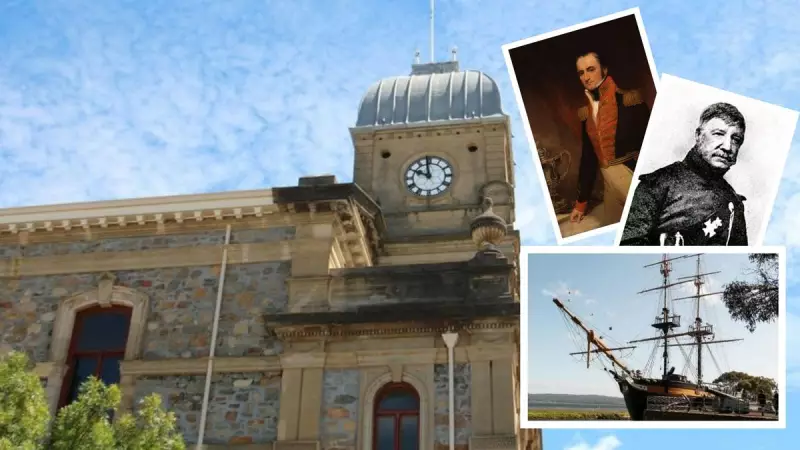
This year, the historic port city of Albany celebrates a monumental milestone: 200 years since its foundation as the first European settlement in Western Australia. The story, however, begins with profound disappointment from the very man sent to establish it.
A Disappointing First Impression
Major Edmund Lockyer stepped ashore at daylight on December 26, 1826, after arriving from Sydney on the brig Amity. His mission was to assess the site at King George Sound. His immediate reaction, recorded in his journal, was one of deep scepticism. He found the country stony and sandy, declaring the whole aspect "most unfavourable" for settlement. History would soon prove his initial assessment wrong.
Lockyer's expedition, comprising 23 convicts and a detachment of the 39th Regiment, was a strategic move by the British Crown. French exploratory voyages in the region, including those by d'Entrecasteaux and d'Urville, had spooked British authorities. They were determined to secure the southern coastline before their great rival could.

Despite his misgivings, Lockyer proceeded. On January 21, 1827, the Union Jack was hoisted, formally claiming British possession. The fledgling outpost was named Frederick's Town, after the Duke of York and Albany. This act predated the establishment of the Swan River Colony (Perth) by more than two years.
Slow Growth and Rising Resentment
Renamed Albany by Governor James Stirling in 1832, the town's early progress was painstakingly slow. When Government Resident Sir Richard Spencer arrived in September 1833, he found a mere 17 settlers with almost no cultivated land or livestock. By the time of his death in 1839, the district had grown to 139 settlers with substantial herds, proving the region's potential.
Key developments like the opening of a road to Perth, a monthly mail service, and the establishment of a whaling industry spurred growth. Albany's strategic importance was cemented in 1856 when it became a port of call for the P. & O. steamer service from England.
Yet, a deep-seated grievance festered. Albany felt neglected by the "centralist government in Perth," dominated by the Swan River Party. Historian Donald S. Garden notes that Albanians believed their port, the busiest and biggest revenue contributor, did not receive its fair share. This bred a powerful sense of alienation and a desire to separate from Western Australia.
The Secession Movement and National Destiny
This discontent boiled over in the 1890s during the federation debates. Albany envisioned a future as a federal port and naval station. When the mail port was moved to Fremantle, the outrage culminated in a full-blown secession movement. The Albany Advertiser thundered on December 26, 1899, that separation was the only escape from "the evils of isolation." A petition was even prepared for Queen Victoria.
Ultimately, Western Australia voted to join Federation. In a telling twist, Albany itself voted overwhelmingly in favour: 914 votes to 67 on July 31, 1900. Just over a decade later, the town etched itself into the national consciousness. In October 1914, King George Sound was chosen as the rendezvous point for the first ANZAC convoy. From its safe harbour, 36 transport ships carrying over 28,000 Australian and New Zealand troops departed for the battlefields of World War I, a solemn departure point for many who never returned.
From a disappointing landing to a strategic outpost, a rebellious town to a site of national gathering, Albany's first 200 years are a foundational chapter in the story of Western Australia and the nation.