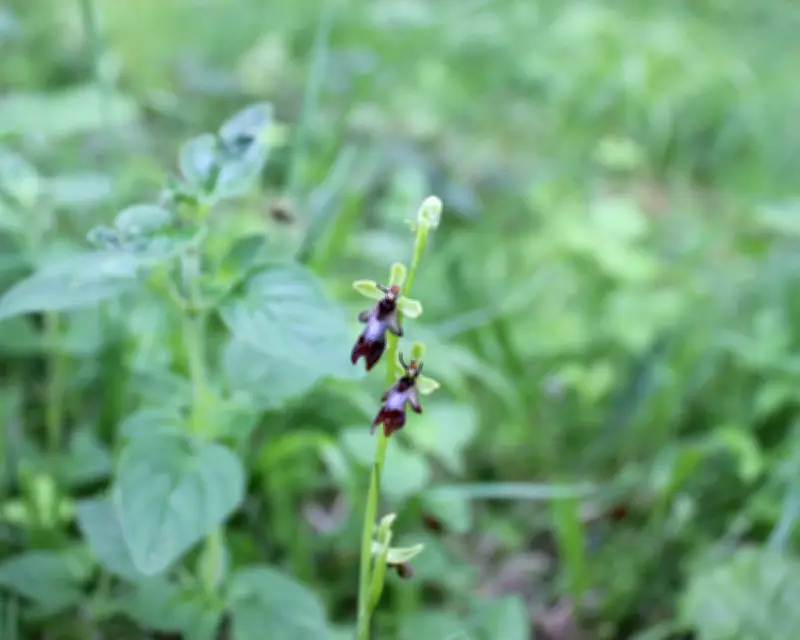
Fly orchid on the South Downs. Photograph: Ollie Southall
Country diary: A tiny orchid with mighty powers of deception
Wolstonbury Hill, West Sussex: The fly orchid looks like no fly I have ever seen; its target insect is a wasp. Even more strange is that neither I nor Charles Darwin have ever seen one being pollinated.

Many British orchids are named for their animal or humanoid appearance. List some and you have all the characters for a nursery-rhyme tale of transformation and trickery: lady, frog, man, fly and spider. Today's protagonist is the fly orchid (Ophrys insectifera), a subtle conjuror of alternate realities and a plant I am fortunate to encounter yearly on my local South Downs hill. Favouring the dappled interface of chalk grassland and woods, it flowers here from mid-May. It is hard to spot amid the bugle, wild marjoram, agrimony and dock, but once I have my eye in, I find upwards of 20 plants.
While they look like no fly I have ever seen, the tiny blooms do have an uncannily insectile appearance. This is mostly down to a special petal, the labellum, which is minutely modified for luring in pollinators. Up close, I can see how its edges are curved back just so, a sleight of folding which gives the illusion of volume. An iridescent blue patch at its centre suggests the sheen of folded wings.
Some orchid names say less about the plant than the human knack for seeing resemblances. The fly orchid, however, belongs to a genus, Ophrys, in which the likeness we perceive is also biologically significant. Thanks to their striking visuals and pheromone-mimicking scents, these plants seduce male insects into attempting sex with them, then stick pollen to their heads. Yet while most Ophrys species are bee-pollinated, the fly orchid is pollinated by a wasp – the digger wasp. This is highly unusual, and suggests that it emerged early in the evolutionary history of the genus, before bees took over pollination duties, driving rapid diversification in the group.
Sadly, I have never seen a wasp go near one of these plants – they have an alarmingly low rate of fertilisation. This puzzled Charles Darwin, who spent years studying a population in Kent and also never saw one pollinated. “It is remarkable … that this Ophrys has not been rendered more attractive to insects,” he wrote. It was not until the 1910s that the pollination mechanism was widely recognised. Nowadays, philosophers and naturalists debate the ethics of the exchange. Does the flower exploit the bee, duping it into a waste of sexual energy? Or does the bee take some pleasure, ensuring a happy ending for both parties?
Under the Changing Skies: The Best of the Guardian’s Country Diary, 2018-2024, is available now at guardianbookshop.com
Explore more on these topics: Environment, Country diary, Rural affairs, Wild flowers, Bees, Insects, Wildlife, Charles Darwin, features.