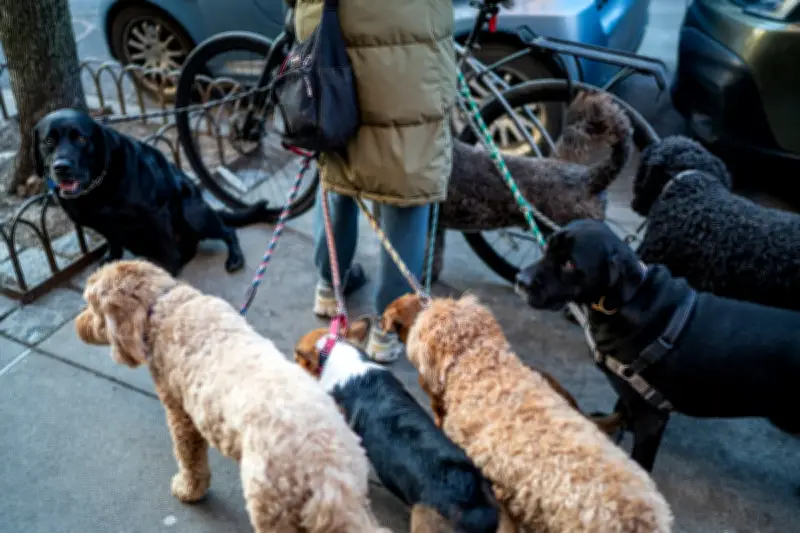
NEW YORK — A professional dog walker, Lope Ramos, pauses to attend to one of her eight dogs in the Brooklyn borough of New York City. The scene, captured by photographer Robert Nickelsberg, highlights a growing urban nuisance: dog waste left on sidewalks and parks.
Complaints on the Rise
Kumar Satya, a physician who has lived in Manhattan’s Washington Heights neighborhood since 2017, loves the local parks and community spirit. However, he notes a troubling trend: an increase in dog feces littering the area. “I grew up in India, where [open] defecation is a problem,” Satya said. “This reminds me of that.” This year alone, at least 175 complaints have been filed from the community board covering Washington Heights, making it the worst-affected area in the city.
Citywide, complaints have steadily risen. In 2022, New York City received 2,100 reports; by 2025, that number reached 2,659. Already this year, over 2,400 complaints have been logged. Ray Legendre, a spokesperson for the office of technology and innovation, attributed the recent spike to a blizzard that revealed weeks of accumulated waste after snow melted.

Health and Quality of Life Concerns
Dog excrement is not only unsightly but also poses health risks. It contains bacteria, pathogens, and parasites that can contaminate local water during heavy rain. Julie Menin, the New York City council speaker, described it as “a quality-of-life issue, which just makes people angry that people are not picking up after their dogs.”
Residents like Harry Berberian, a Brooklyn resident and dog owner, often witness pet owners distracted by phones or other tasks. “I am one of those neighbors who goes out of my way to say something,” Berberian said. However, his polite reminders are often met with displeasure. Others, like Crystal Lee in Bedford-Stuyvesant, have captured repeat offenders on camera. Despite submitting evidence, the sanitation department found no violation in her case, leading to frustration: “Either I just accept that I’m going to continue to have to pick up after his dogs, or I can go nuclear.”
Legislative Efforts
In response, city council members have introduced the Safe and Clean Outdoor Ownership Practices (Scoop) Act. This legislation proposes measures such as regularly filling waste bag dispensers, installing signs about penalties, establishing a composting pilot program, and launching an outreach campaign. “It’s not an enforcement approach. It’s an education, awareness and deterrent approach,” Menin said.
Enforcement remains challenging. Despite patrols in high-complaint areas like Washington Heights and Harlem, the sanitation department issued only two summons last year. “The chances of someone not picking up after their dog while an enforcement officer is watching is very, very slim,” Vincent Gragnani, press secretary for the sanitation department, stated.
National and International Trends
The problem is not unique to New York. In San Francisco, complaints about dog or human waste surged 400% between 2012 and 2021. In the United Kingdom, the phenomenon of poop bags hanging from trees earned the nickname “the hanging gardens of jobbylon.” Pet ownership has increased significantly, from 76 million dogs in 2016 to nearly 88 million in 2021, contributing to the issue.
Residents like Diane O’Dwyer, who lived in the UK, point to more aggressive enforcement elsewhere. In Liverpool, a contractor issued 45 fines in July 2025. “I know it’s a tough city to deal with,” O’Dwyer said of New York, “but don’t have fines posted and not enforce them.”