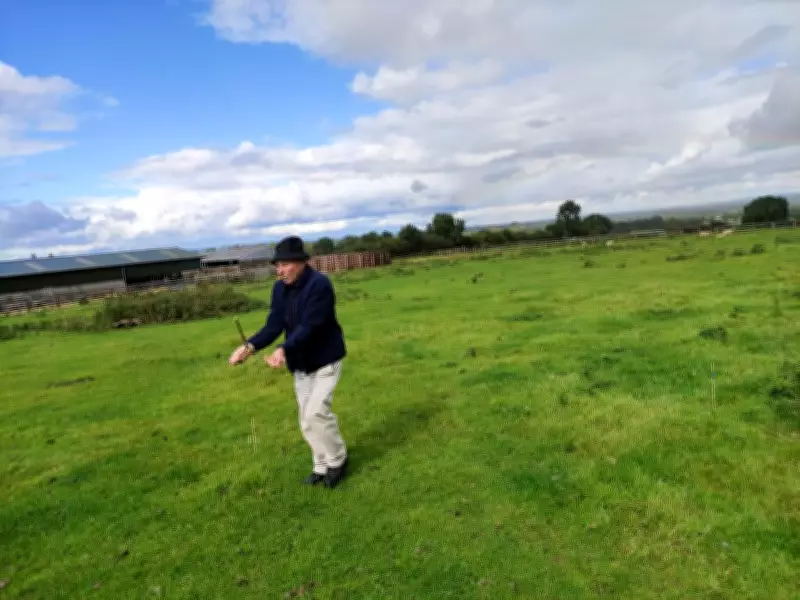
Standing in a field in the Irish countryside, watching a man shuffle along the grass with a pair of small L-shaped metal rods in his hands, I am struck by how this is one of my most offbeat travel moments in recent years. The man is Gerry Cremin, and he is demonstrating the ancient, yet still very much alive, art of divining.
“If the rods cross, it could mean we’re in business,” he says mysteriously. Also known as dowsing and sometimes water witchery, this practice was first used thousands of years ago to help humans locate materials of interest such as natural wells or minerals. While angled metal rods are now the favoured apparatus for Irish diviners, in bygone times they would have used Y-shaped tree branches or pendulums.
Gerry explains that the rods must be held gently but firmly, with the long ends pointing forwards. If they cross as you walk, there is a good chance there is water or something else below. Although he did not take up divining until he moved to Dublin as a young man in the 1970s, Gerry says he was aware of it from childhood. As he speaks, traces of his Cork accent are still evident. Where he grew up in the rural south-west of Ireland, dowsers were a key part of the community, particularly useful for people wishing to build homes near a reliable water source.

Technological advancements and accusations of pseudoscience mean dowsers are not quite as in demand as they once were. However, divining is among an array of pagan ways that are being kept alive or rekindled on the Emerald Isle. Gerry is a member of the Irish Society of Diviners, a not-for-profit organisation that stages meetings and events to encourage uptake of this art form. “I do believe most people can do it if they put their mind to it,” he says. “It’s a skill that we needed in our past and it’s something you can resurrect.”
I try my hand at divining, taking a spare pair of rods from Gerry’s bag before marching across the field, dodging stinging nettles and droppings deposited by local sheep. Hoping for some kind of reaction from the rods, nothing transpires. The same happens when I try divining with one of Gerry’s Y-shaped branches, which are supposed to bend towards the ground when approaching a water source.
Gerry seems an earnest fellow, but my scepticism runs deep. I am aware of the criticisms of this practice. Some claim it is driven by the so-called “ideomotor effect”, where beliefs or suggestions trigger involuntary muscle movements, a similar phenomenon attributed to the use of ouija boards. Critics in Ireland also point out that this island is not exactly short of streams, underground or otherwise, so you are bound to find a water source sooner or later.
What is undeniable is the air of mysticism around the practice. It is perhaps no accident that divining hotspots are found in places long associated with ley lines, energy fields, and druidic heritage. Across the Irish Sea in the south-west of England, for example, diviners often flock to Stonehenge and Glastonbury. Gerry says he has discovered energy lines around Ireland, and we are dowsing with him by the Hill of Tlachtga (Hill of Ward), a Bronze Age hill fort in the Boyne Valley of County Meath, an hour’s drive from Dublin and strewn with neolithic burial chambers and other evocative ruins.
Named after both a legendary ancient druidess (Tlachtga) and a former landowner (Ward), this grassy mound has been cited as the earliest ceremonial bonfire site of Samhain, the ancient Celtic forerunner to Halloween, when it was thought the veil between the worlds of the living and the dead was at its thinnest. In recent years, the Samhain traditions have been revived for the Puca Festival, which now takes place annually at locations in Meath at the end of October. The festival offers a string of entertainment and activities, and last year Gerry ran a few divining workshops at this hill. Keep an eye out for the 2026 Puca itinerary if you are interested in attending one.

Despite Gerry assuring us that there is a lot of “spirit energy” here, my divining experience remains inconclusive. As we pack the rods and branches back into Gerry’s bag, something happens. The sun disappears, strangled by a flotilla of thick clouds, with the sky, bright only seconds ago, suddenly dark and gloomy. Then the rain starts lashing down. “Ah, the water found us,” says Gerry deadpan, as we dash for cover.
Steve McKenna was a guest of Tourism Ireland, which has not influenced this story or read it before publication. For more information on visiting County Meath and Ireland, see discoverboynevalley.ie and ireland.com.