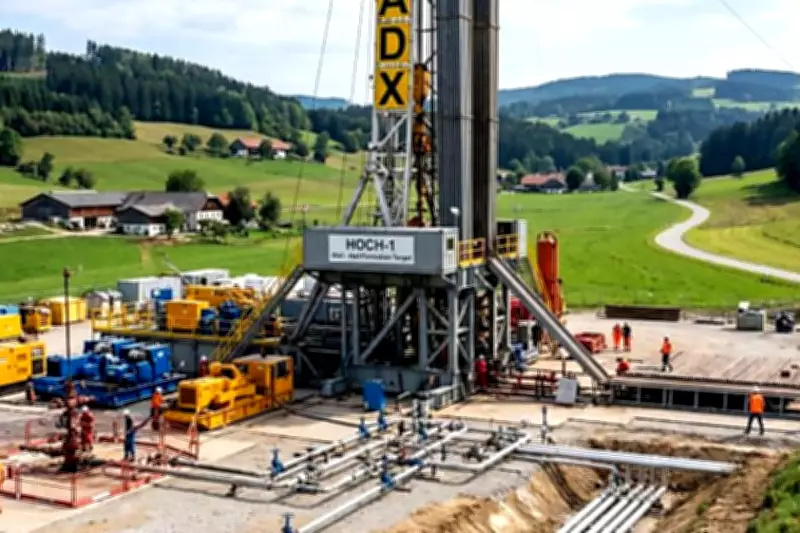
ADX Energy has strengthened the commercial case for its HOCH-1 shallow gas discovery in Austria after wireline logging confirmed seven gas-bearing intervals. The zones are now primed for completion testing at the shallow gas well ahead of a follow-up drilling program across its broader acreage in Upper Austria.
Gas Zones Identified
The company says the stacked sections contain a combined 4m to 6m of net gas pay and despite the slender reservoir thicknesses, analogue production fields nearby suggest the sands could still punch out strong flow rates.
HOCH-1 sits within ADX’s ADX-AT-I licence in Upper Austria and is the opening shot in the company’s three-well 2026 shallow gas campaign. The prospect carried a pre-drill mean prospective resource estimate of 8 billion cubic feet (Bcf) of gas with upside to 17.3Bcf before the newly recognised deeper intervals entered the equation.

Drilling and Logging Results
The well spudded on 16 April and has now reached a total depth of 1,685m after management pushed the hole deeper in response to persistent gas shows below the original target zone. A comprehensive wireline logging program has since been completed across the full prospective Base Hall reservoir section.
ADX intersected the intra-Hall target between 1,354m and 1,368m depth, right on the mark of its pre-drill 3D seismic and amplitude-supported model. Logging later revealed the interval comprised millimetre-scale sandstone bands interbedded with mudstones, explaining the broad gas readings without sharp gas peaks encountered while drilling.
The company has concluded the low net-to-gross reservoir quality means the intra-Hall target is unlikely to be commercially viable at HOCH-1. ADX noted the low net gas sand count within the main target had already been identified as the key pre-drill exploration risk.
Deeper Opportunities
However, management now believes the stronger opportunity sits deeper within the seven gas-bearing intervals of the Base Hall channel section, between 1,465m and 1,617m, which are now primed for completion testing.
Although the reservoirs appear relatively thin - from 0.3m to 1.5m thick - ADX says nearby analogue Hall Formation fields have demonstrated similar sands can still produce strong commercial gas flows. Offset wells in the basin have reportedly flowed at rates of up to 9 million standard cubic feet of gas per day, equivalent to 1,500 barrels of oil equivalent per day.
The wireline logging program has identified 4 to 6 metres of net gas pay across seven intervals. The multiple relatively thin gas sands can deliver high production rates based on offset well data and producing fields for the base hall formation.
ADX Energy executive chairman Ian Tchacos said: "The wireline logging program has identified 4 to 6 metres of net gas pay across seven intervals. The multiple relatively thin gas sands can deliver high production rates based on offset well data and producing fields for the base hall formation."
Next Steps
The company has now drilled through the full Base Hall channel sequence and into the Upper Puchkirchen Formation. The next stage will involve running and cementing 4.5-inch casing before installing completion equipment and perforating selected intervals for production testing.
Management says the final testing design remains under review, although the multiple zones are expected to be tested together in a “co-mingled” configuration to maximise potential flow rates.
Future Campaign
HOCH-1 is the first of three shallow gas prospects planned for drilling in Upper Austria in 2026. Just 2km from open-access pipeline infrastructure, the well offers ADX a fast-track route to commercialisation if testing confirms the encouraging drilling and logging results.
The company also has the GOLD-1 and SCHOEN-1 shallow gas prospects queued up and permitted for drilling later this year as part of a broader clustered development strategy across Upper Austria. ADX believes shared infrastructure and streamlined tie-ins could underpin a scalable regional gas hub.

The shallow gas campaign complements ADX’s existing production and cash flow from its Vienna Basin and Anshof operations, providing another layer of near-term growth alongside the company’s deeper-running Welchau oil and gas project. Management says the strategy is well timed against Europe’s push for secure domestic energy supplies and the region’s continued shift away from reliance on Russian gas imports.
With seven gas zones now teed up for testing and the drill bit already backing the seismic model, HOCH-1 appears to be rapidly transforming from a simple wildcat into a potentially repeatable shallow gas growth story in the heart of Europe.