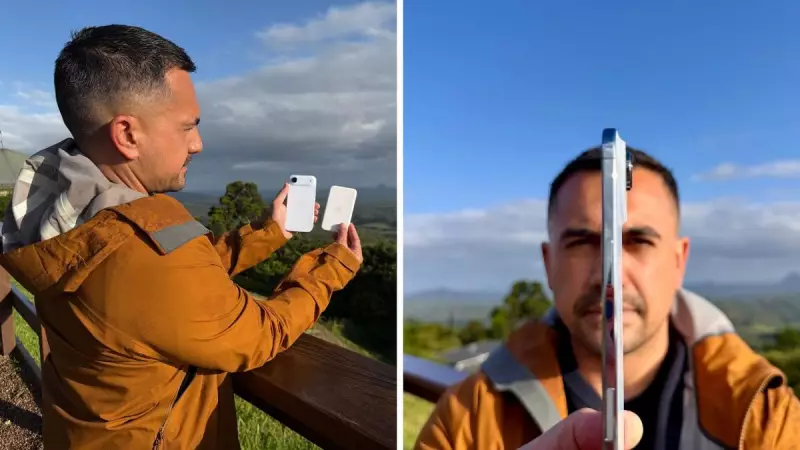
If you're focusing on lens count when evaluating the iPhone Air, you're approaching Apple's latest smartphone from entirely the wrong perspective. After using this device extensively for a month, I can confidently say it represents the first iPhone in years that has genuinely transformed my daily mobile habits. This transformation doesn't stem from flashy new features or groundbreaking specifications, but rather from how remarkably comfortable it feels in hand and how quickly it disappears from conscious thought during use.
Rethinking Form Factor: A Step Toward Foldable Futures
This matters significantly because the iPhone Air feels like Apple's return to serious experimentation with physical design. While foldable iPhone rumors have circulated for years with no confirmed release date, the Air appears to be a deliberate step in that direction. Much of the initial criticism has centered on one particular aspect: the camera system. With just a single rear lens, no Ultra Wide capability, and no dedicated telephoto lens, many consumers have questioned Apple's thinking, especially at the starting price point of $1,799.
On paper, this reaction seems perfectly reasonable. Compared directly with Pro models, the specification list appears significantly stripped back. However, this narrow focus completely misses what this innovative device is genuinely attempting to accomplish.

A Testing Ground for Future Innovation
Before discussing cameras or performance metrics, the iPhone Air makes considerably more sense when viewed through the lens of Apple's apparent strategic direction. Industry whispers consistently mention cleaner screens, fewer display cutouts, increased on-device artificial intelligence processing, and eventually, a foldable iPhone. Before Apple can reach these ambitious goals, the company must first demonstrate it can create an iPhone that's substantially thinner and lighter without compromising the everyday user experience.
This is precisely where the Air functions as a crucial test run. When a smartphone becomes this exceptionally thin, manufacturers cannot simply shrink every component proportionally. Camera modules can only be reduced so far before image quality deteriorates noticeably. Batteries resist excessive compression. Processing chips still require adequate space to maintain optimal temperatures and prevent thermal throttling.
The prominent camera bump actually reveals much about Apple's engineering approach. Rather than thinning the camera system and sacrificing photographic performance, Apple maintains full-size components while utilizing internal space with unprecedented efficiency. Fewer lenses enable tighter internal packing and a sharper focus on elements that impact daily usability most significantly.
Design and Construction: The True Story
This is where the iPhone Air ultimately succeeds or fails. During my first dinner outing with the device, I genuinely believed I had left my phone at home entirely. I repeatedly checked my pocket because the familiar presence simply wasn't there in the usual manner. When I finally retrieved it to respond to a message, the remarkable lightness caught me completely off guard. Measuring just 5.6 millimetres thin and weighing only 165 grams, it barely registers as a traditional iPhone in hand.
This exceptional lightness fundamentally alters how you interact with the device. One-handed typing becomes effortless. Capturing quick photographs without awkward hand adjustments feels completely natural. There's no noticeable bulk in your pocket, you frequently forget it's even there, and you don't experience the constant urge to remove it repeatedly.
Durability considerations did cross my mind, and I am currently using a protective case. However, I've opted specifically for a bumper case that preserves the Air's essential character. Unlike heavy-duty cases that wrap the entire back, this minimalist protection primarily absorbs impacts on edges and corners during accidental drops. I would still recommend a screen protector for particularly cautious users.
Even with this minimal protection added, the iPhone Air feels noticeably slimmer than any smartphone I've carried in recent years. Weeks into regular use, it remains somewhat astonishing to extract an iPhone from your pocket and recognize just how extraordinarily lightweight it truly is.

Camera Philosophy: Less Hardware, More Simplicity
This is where online commentary has been most vocal and critical. On the rear, you receive a single 48-megapixel main camera sensor. That means one rear lens only—no Ultra Wide capability and no dedicated telephoto lens. Apple does include its 2x optical-quality digital zoom option derived from the main camera, but this represents a different configuration compared to Pro models. If you're accustomed to frequently switching between multiple lenses while photographing, this might initially feel like regression.
After a full month of use, however, Apple's intent becomes remarkably clear. This camera system prioritizes simplicity above all else. You point, you shoot, and you continue with your day. The primary sensor proves robust and reliable, handling the types of photographs most people actually capture daily without requiring constant technical consideration.
There's also one clever feature Apple highlighted during launch that's easy to underestimate: the Center Stage front-facing camera. The selfie camera captures a wider field of view than expected, and Center Stage automatically keeps you framed during video recording. For group selfies, spontaneous travel moments, or casual video clips, it covers more situational ground than many assume. While not equivalent to having a rear Ultra Wide lens, it rescues users more frequently than anticipated.
If you particularly enjoy extreme zoom capabilities, super-wide perspectives, or constant lens switching, this isn't the ideal iPhone for your needs. However, if you primarily desire consistently good photographs and video without technical fiddling, it performs the task surprisingly effectively.
Battery Performance and Minor Frustrations
Battery life proves solid, especially considering how exceptionally thin this smartphone is. It comfortably survives a full day of normal usage without causing anxiety, which represents the essential baseline expectation here. My personal greatest concern isn't endurance, however. It's the conceptual contradiction of attaching Apple's MagSafe Battery Pack to the device. While this accessory extends usage time, it fundamentally contradicts the entire purpose of this phone. You spend considerable time appreciating how light and slim the Air feels, then attach a substantial battery pack to the back and completely negate the core experience.
Display and Performance: Seamless Experience
This section of the review features nothing that genuinely obstructs the user experience, which essentially represents the entire point. The screen is a 6.5-inch OLED panel with 120Hz ProMotion technology, which in practical terms means it's sufficiently large for videos, reading, and maps while delivering properly smooth scrolling. It never feels oversized, remains easy to operate single-handedly, and contains no genuinely annoying characteristics. It simply performs its function reliably.
The same principle applies to processing speed. It operates using Apple's latest A-series chip, meaning applications launch instantly, multitasking flows effortlessly, and nothing ever feels sluggish or cumbersome. You don't consciously consider performance metrics, you don't analyze the display specifications, and this represents exactly how premium technology should function. During daily use, all these elements fade seamlessly into the background, which might sound mundane but actually allows the revolutionary lightness and innovative form factor to dominate the experience.
The Foldable Phone Landscape: Current Competition
The year 2025 marked when foldable smartphones stopped feeling like technological novelty acts. Samsung's Galaxy Z Fold7 provided the clearest indication that the company has finally perfected the form factor—thinner, lighter, with a refined hinge mechanism and a screen that feels authentically premium. Samsung even promotes the device with an Ultra 200MP camera included, challenging the conventional wisdom that folding designs necessitate photographic compromise.
Google's latest offering in this category is the Pixel 9 Pro Fold, which distinguishes itself through its Gemini-first experience deeply integrated throughout the operating system, making particular sense on the larger interior display. Meanwhile, Honor's newest model is the Magic V5, pursuing one objective relentlessly: extreme thinness (with its "world's thinnest" claim attached to a specific model finish) while maintaining flagship-level specifications throughout.
Samsung has also been observed experimenting with tri-fold prototypes and patent designs, providing the clearest hint that the next evolutionary phase for this product category is already under active development.
Identifying the Ideal User
This isn't an iPhone designed for specification enthusiasts. It's not concerned with boasting the most camera lenses or the largest numbers on technical specification sheets. The iPhone Air targets individuals who desire an iPhone that's as slim and lightweight as physically possible while remaining within the Apple ecosystem. If you appreciate how iPhones function, utilize Apple services regularly, and simply want something easier to carry and operate daily, this device makes logical sense.
You're exchanging additional lenses and hardware flexibility for a smartphone that feels superior in your pocket and hand. After extensive real-world testing, I found myself genuinely impressed by how much capability Apple managed to incorporate into something this exceptionally thin.