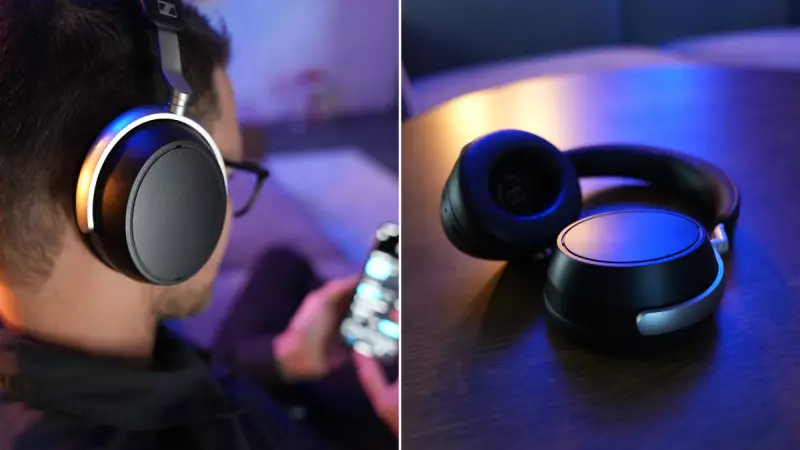
For years, a vast chasm has separated the world of true audiophile sound from the convenience of wireless headphones. The prevailing wisdom held that a physical cable was the only reliable path to audio nirvana. However, Sennheiser is now boldly challenging that notion with its new flagship model, the HDB 630, promising 'Audiophile Sound, Cut Loose.' After extensive testing, it's clear this isn't just marketing hype.
A New Standard in Wireless Audio Quality
Having tested countless mainstream Bluetooth headphones, I can state without reservation that the Sennheiser HDB 630 are the best-sounding over-ear Bluetooth headphones currently available. Right out of the premium-feeling case, they deliver a hyper-detailed, rich audio experience with excellent response across all frequencies.
The standard 'Neutral' EQ setting is superb, but the companion Smart Control Plus app offers a powerful parametric EQ for fine-tuning, even if its interface is slightly clunky. The joy of listening with the HDB 630 comes from discovering new layers in familiar tracks. The separation of percussion in Earth, Wind & Fire's 'September' is elite. A faint signal noise from Gary Moore's guitar in 'The Prophet,' previously inaudible, becomes clear. The punchy bass in Daft Punk's 'Giorgio by Moroder' adds swagger without overwhelming the melody.

The Secret Weapon: The BTD 700 Bluetooth Dongle
The package includes expected accessories like a 3.5mm audio cable, USB-C cable, and flight adapter. The game-changer, however, is the BTD 700 Bluetooth dongle. This small device makes a monumental difference by enabling a high-resolution, low-latency connection. The jump in audio clarity is immediately noticeable, and the low-latency mode performs exceptionally well. It's a remarkable accessory that elevates the entire experience.
Noise Cancellation and Smart Features
The active noise cancellation (ANC) on the HDB 630 is competent and on par with other high-end models. The 'Adaptive' mode is effective, and transparency mode works fine. However, the dedicated 'Anti-wind' feature proved disappointing in breezy conditions, where turning ANC off entirely was often preferable. When compared to class leaders like the Sony XM6, the Sennheiser's sound quality is vastly superior, but Sony retains the crown for absolute noise-cancelling prowess.
The Smart Control Plus app is feature-rich. Beyond sound customisation, it allows users to set up automatic 'sound zones' that change EQ or ANC presets based on location—perfect for boosting bass at the gym or enhancing vocal clarity for work calls. Connection Management lets you seamlessly switch between devices. A 'Find headphones' feature logs the last disconnection location on a map, a handy tool for the forgetful, though live tracking like an Apple AirTag would be a welcome future upgrade.
The Premium Price and the Momentum 4 Comparison
A significant point of discussion is the HDB 630's relationship to its more affordable sibling, the Momentum 4. The Momentum 4 are excellent headphones for most consumers, offering great sound, battery life, and ANC at roughly one-third of the price. A potential misstep by Sennheiser is the lack of distinct design differentiation; the HDB 630 doesn't look sufficiently premium next to its little brother. The use of plastic yokes and heavy reliance on touch controls feels at odds with its elite audio performance.
With a price tag of $899 on Sennheiser's website and $998 on Amazon, the HDB 630 is a major investment. This is not a product for the average listener. It is designed for the audiophile who prioritises sound quality above all else—the person who would happily use a coiled cable and a DAC for a lossless commute. For that listener, the message is clear: the era of Bluetooth headphones being excluded from the audiophile realm is officially over.