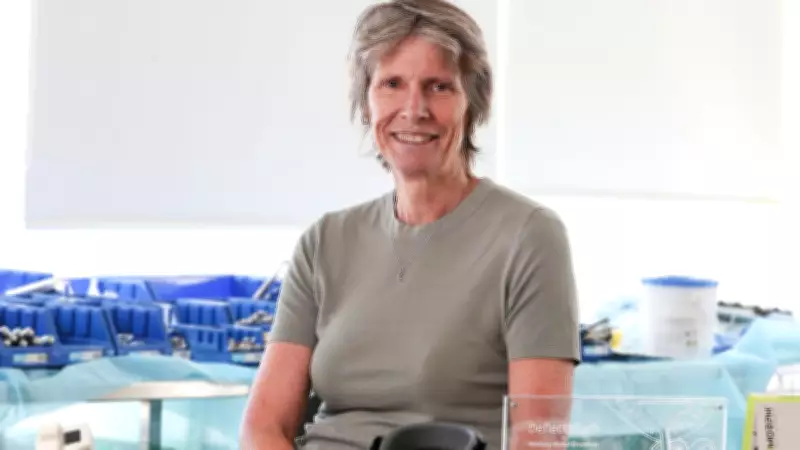
Professor Karen Reynolds’ office at Flinders University is a place where curiosity meets real-world problem-solving. For nearly 30 years, she has been shaping biomedical engineering in Australia, helping turn ideas into devices that can save lives. And while her work sounds hi-tech, it all started with a simple fascination.
A career born from curiosity
“I always loved medicine and the human body, but I didn’t think I wanted to be a doctor,” she says. “Then, at about 15, I saw something called biomedical engineering in a careers handbook. I thought, ‘That’s exactly what I want to do’.”
Back then, biomedical engineering was barely on the map. There were no degrees, so Professor Reynolds studied physics before finding a masters program in the field. She didn’t set out to become an academic, but a series of research opportunities – and a job at Flinders University in 1997 – kept her in the lab. “Flinders was perfect,” she says. “We shared a campus with a teaching hospital, and it was the first university in Australia to offer an accredited biomedical engineering degree. The job description basically sounded like it was written for me.”

From heart valves to cancer probes
Reynolds’ career covers an extensive range of projects. Early work involved pulse oximeters – the little devices clipped on fingers to measure blood oxygen – and prosthetic heart valves that were failing in patients. Later, she turned her focus to surgical tools, figuring out how to safely implant screws in bone and prevent failures in the operating theatre.
But her talents truly shone through in the Medical Device Partnering Program, which she established in 2008. The program acts like an incubator for ideas, guiding clinicians and even independent inventors through the complex process of bringing medical devices to market. “We see 60 to 100 ideas a year,” she explains. “Some are simple assistive devices, like something to help a person stand. Others are implantable electronics that need to be tightly regulated. Every day, a new idea pops up, and it’s thrilling to help it along.”
“It’s not just about the tech – we want to make sure these ideas actually get to patients who need them.”
Bridging the gap between lab and patient
Helping ideas survive beyond the lab is just as important as the engineering itself. Professor Reynolds’ team advises on commercial potential, regulatory hurdles, and prototyping. One standout project is a cancer-detecting probe that measures tissue acidity to locate tumours. These days technology is moving at lightspeed with examples such as cloud connection, AI or even drug-delivering implants, but Professor Reynolds and her team are navigating that complexity with optimism.
“Things are more complex than ever,” she says. “But that also makes the opportunities amazing.”
That spirit of possibility now extends well beyond the medical sphere. As the newly appointed Director of the Flinders Factory of the Future, Professor Reynolds is at the helm of the transdisciplinary advanced manufacturing Research Hub where technology, engineering, and human factors come together to deliver practical, evidence-based solutions. She and her team are driving productivity, reducing costs, and opening new frontiers in advanced manufacturing.
Recognition and teamwork
Recognition has followed, being named Professional Engineer of the Year in 2010 and Scientist of the Year in 2012, but she says the awards reflect her team more than her. “As an academic, you’re only as good as the people you work with,” she says. “I have colleagues who bring expertise in governance, research, industry partnerships, and working with First Nations communities. Any success I’ve had is about the team, not me.”
Her approach to innovation goes beyond engineering – it’s about connecting people, ideas, and opportunities. “It’s not just the technical problem,” she says. “Success comes down to understanding the need, navigating the regulatory pathway, and making the right connections. Even the most brilliant idea will stall without the right support behind it. Our job is to bridge that gap – to take promising concepts and help shape them into solutions that genuinely improve lives.”

Thriving on innovation
Even with decades of experience, Professor Reynolds says she still gets a thrill from seeing a good idea take off. “Sometimes you see a fantastic concept and it doesn’t go anywhere – not because the idea itself is bad, but because of funding constraints, or the wrong connections,” she says. “Our role is to spot those ideas early and help them along so patients can benefit.”
From heart valves to cancer probes, from surgical instruments to cutting-edge industry innovation, Professor Reynolds’ impressive body of work is bridging the gap between science and impact. “Every day there’s something new,” she says. “Biomedical engineering is about problem-solving in the real world, and there’s nothing more satisfying than seeing it make a difference for someone.”