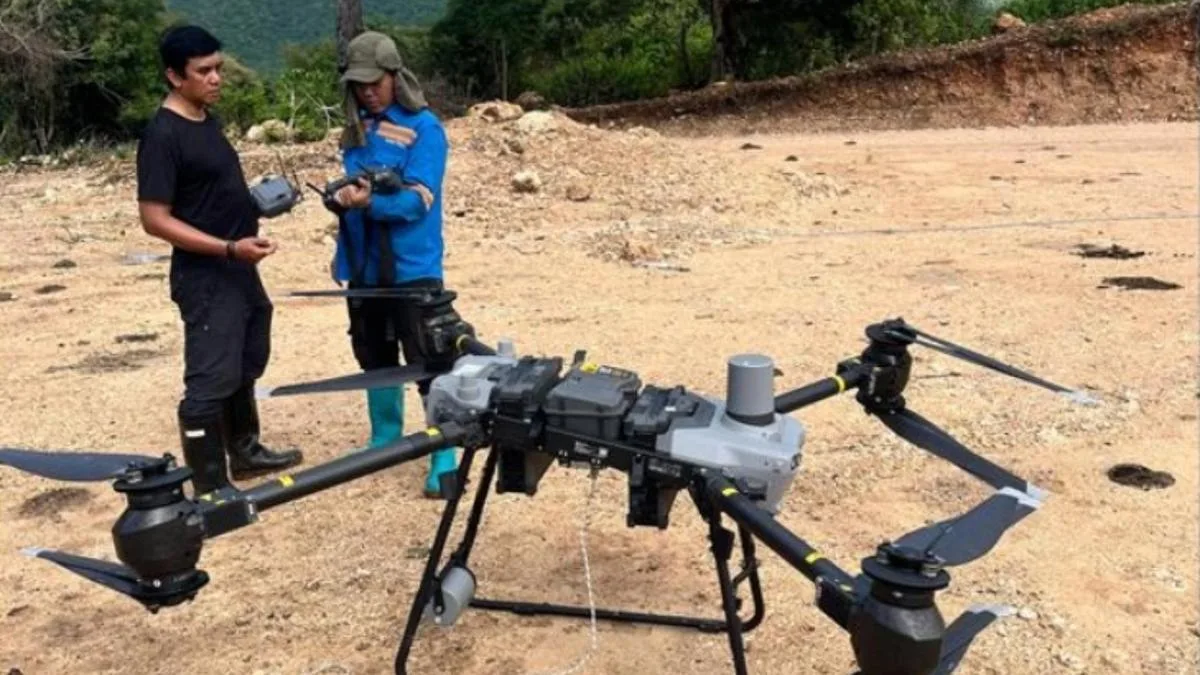
Estrella Resources has launched an advanced drone-deployed passive electromagnetic survey at its Ira Miri project in Timor-Leste to hunt for deep-seated manganese mineralisation. The MobileMTd system, developed by Expert Geophysics, will test structural extensions of high-grade manganese and determine if a larger mineralised system exists below.
Previous ground-based induced polarisation surveys identified anomalies but were limited in depth. The new audio-frequency magnetotelluric (AFMAG) technology uses natural passive electromagnetic fields to map subsurface resistivity and structural features down to 800 metres depth. The airborne unit captures near-continuous data at a five-metre sampling interval, providing high-spatial-resolution imaging across a five-kilometre corridor.
The drone survey avoids ground-based transmitter infrastructure and collects data rapidly across rugged terrain with minimal environmental disturbance. Field data collection is expected to take three weeks, with final processing and interpretation within two months. Results will refine geological models and prioritise deeper targets for drilling, and support a Category A mining licence application.

Estrella recently completed a successful extraction program, stockpiling 27,371 tonnes of manganese ore with a weighted average grade of 28.64% manganese. Direct sampling of the pit floor and walls yielded grades up to 60.22% manganese. The company also unveiled a 621-million-tonne maiden resource at its nearby Werumata limestone project, suitable for industrial acid neutralisation.
Shipment preparations and export approvals for the stockpile ore are slated to wrap up in late May, with an exclusive sale process in early June. Estrella aims to unlock the full scale of its Ira Miri manganese project.