Norwegian skiing sensation Fredrik Møller faces a race against time to compete at the Winter Olympics after a harrowing high-speed crash during a training run. The incident has cast extreme doubt over his participation in the remainder of the Games, dealing a significant blow to his gold medal aspirations.
A Devastating Crash on a Notorious Slope
The 25-year-old athlete lost control on a treacherous bend during the first downhill training session on the infamous Stelvio slope in Bormio, Italy. This course is widely regarded as one of the most challenging and demanding in the world, testing even the most experienced skiers to their limits.
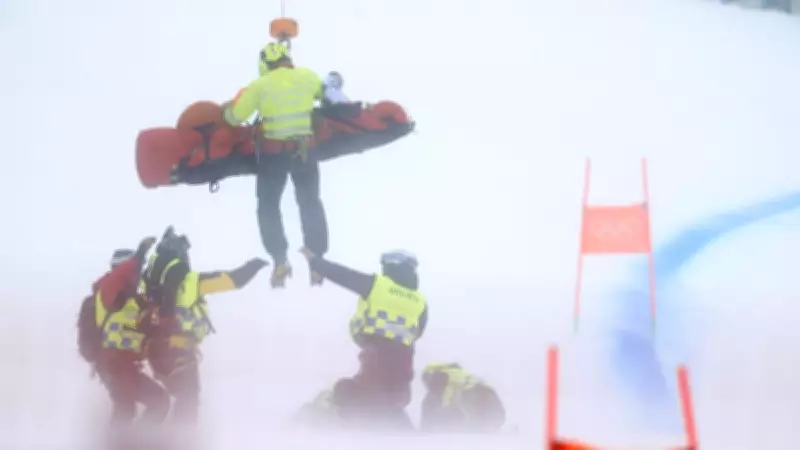
Møller went down hard in the crash, immediately prompting medical staff to rush to his aid. Given the severity of the incident and the remote location, he was airlifted by helicopter to a nearby hospital for urgent assessment and treatment.

Diagnosis and Immediate Aftermath
Medical examinations later confirmed that Møller sustained a dislocated left shoulder in the fall. National team doctor Trond Floberghagen provided an update on the skier's condition, stating that the initial treatment had proceeded well.
"Fredrik sustained a dislocated left shoulder. The treatment went well, and the medical team will now begin further rehabilitation," Floberghagen explained. "Møller did not suffer any other injuries in the crash."
This news comes as a particular disappointment given Møller's recent form. He was considered a genuine contender for Olympic gold after triumphing in the most recent World Cup super-G event on this very same challenging course in 2024.
Olympic Participation Hangs in the Balance
While the medical team initially refrained from speculating about his Olympic future, they have since made the difficult decision to rule Møller out of the men's downhill event scheduled for Saturday local time. The tight recovery timeline simply proved too challenging for this particular discipline.
"The timeline for the downhill is unfortunately a bit too tight," Floberghagen told Norwegian broadcaster NRK. However, a glimmer of hope remains for the super-G event scheduled for February 11th.
"Then, we will see if it is realistic to start the super-G, but we have to assess that continuously," the doctor added, indicating that Møller's team will monitor his rehabilitation progress day by day.
Training Continues Amidst Setbacks
As Møller begins his recovery, training sessions for other athletes have proceeded. American skier Ryan Cochrain-Siegle posted the fastest time in the training run, finishing ahead of local hope Giovanni Franzoni and Switzerland's Marco Odermatt.
Meanwhile, the women's competition faced its own challenges. The first practice session for the women's downhill event in Cortina d'Ampezzo was cancelled entirely due to deteriorating weather conditions and heavy snowfall.
FIS chief race director Peter Gerdol explained the decision, noting "the heavy snowfall is ongoing and the weather forecast does not allow us to reasonably plan the training for tomorrow."
Lindsey Vonn's Determined Comeback Bid
This cancelled session was particularly significant for American skiing icon Lindsey Vonn, as it would have marked her first run since suffering a devastating ACL rupture earlier in the week. The 41-year-old champion faces her own battle against time and injury.
Vonn revealed that the damage to her left knee included a "completely ruptured" ACL, significant bone bruising, and additional meniscal damage. Despite this severe injury, the veteran skier remains remarkably determined to compete.
After three days of intensive physical therapy and following medical advice, Vonn attempted skiing on Tuesday. Observers noted she showed no visible limping as she entered and exited a subsequent news conference, a positive sign in her recovery journey.
"My knee is not swollen, and with the help of a knee brace, I am confident that I can compete on Sunday," Vonn declared with characteristic resilience. "And as long as there's a chance, I will try ... I will do everything in my power to be in the starting gate."

Her determination underscores the extraordinary physical and mental challenges athletes face in their pursuit of Olympic glory, especially when confronting significant injuries just days before competition.