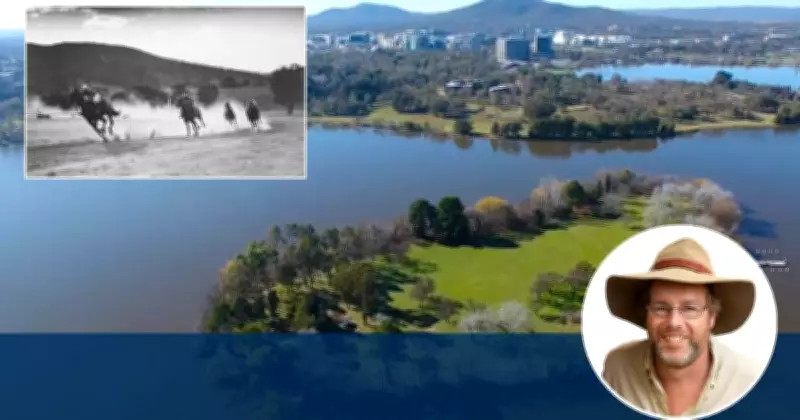
On a sweltering summer afternoon, the tranquil waters of Lake Burley Griffin offer little hint of the thrilling history hidden beneath their surface. As kayakers paddle near Springbank Island, they glide directly over what was once the bustling Acton Racecourse, Canberra's first official horse racing venue.
A Century Since the First Canberra Cup
February 12, 1926, marked a significant moment in the capital's sporting history. On that day, the inaugural Canberra Cup was run at the Acton Racecourse, located where the lake now flows between Springbank Island and Parkes Way. The winner was 'Spec' from the McCormack stables in Crookwell, though detailed records of that historic race remain scarce.
Canberra was still establishing itself as the national capital at that time. The area where the National Museum of Australia now stands was occupied by temporary government buildings, with only Canberra House and scattered farmhouses dotting the landscape.

The Primitive Track That Defied Odds
The Acton Racecourse was far from luxurious. Carved into the Molonglo River flats in 1921 by P. F. Douglas and volunteers, the track measured just six-and-a-half furlongs. It lacked proper facilities for spectators, horses, and jockeys, and was deemed too short for formal recognition by the Australian Jockey Club.
Despite these limitations, the racing community embraced it. After several charity races, the Canberra Racing Club was established in late 1925. However, attracting competitive fields and crowds to the remote Limestone Plains proved challenging from the start.
Racing historian Greg Blood notes, "Many labourers and tradesmen, the greatest supporters of racing, had departed the city during the Great Depression, making revival difficult."Colorful Incidents and Challenges
The track's notorious dip, where horses momentarily disappeared from view, became legendary. "What happened between the jockeys in that dip, stayed in that dip," recalls horse racing enthusiast Jim Paterson, who shared stories of the sunken track during his popular boat tours.
Financial struggles plagued the club early on. In 1927, organizers hoped a mid-week meeting following the opening of provisional Parliament House would boost attendance. Instead, heavy rain kept crowds away, nearly ending the club's operations.
Tensions ran so high that, according to historian Don Selth, one member struck the secretary so forcefully that his denture broke and he required hospital treatment. The club also faced unusual obstacles like sheep wandering onto the track during the 1929 Farewell Handicap, forcing officials to declare 'no race.'
War, Reconstruction, and Eventual Submersion
World War II delivered another blow, with petrol rationing preventing horses from traveling to Canberra. After the war, the Department of the Interior extended the track, accidentally disrupting the adjacent Federal Golf Club's fairways and causing significant controversy.
Racing enjoyed a resurgence in the late 1940s, but the track's fate was sealed when plans for Lake Burley Griffin were announced. The racing community initially resisted moving to the new Thoroughbred Park in Lyneham, questioning whether spectators would travel that far from the city center.
Allen Mawer records in his history of Canberra, "They wondered whether spectators would be prepared to travel that far out of town." Today, that same Lyneham location faces urban infill proposals, highlighting how dramatically times have changed.
Centenary Celebrations and Lasting Legacy
This year marks the centenary of the Canberra Cup, though the race hasn't run continuously. Cancellations occurred during the Great Depression, World War II, and occasional modern disruptions. The 2026 running will take place at Thoroughbred Park on Black Opal Stakes Day, March 8.
The Acton Racecourse operated from 1925 to 1962, hosting regular meetings, picnic races, and charity events. The ACT Jockey Club formed in 1947, drawing over 600 people to its first meeting, though poor weather sometimes forced spectators to shelter in horse stalls.

Roger Norton of Cooma recalls attending a 1959 meeting shortly after turning 18: "It wasn't a very long straight, so leaders won most of the races." His memory is among many preserved through the Sunken Stories of Old Acton project, which collects firsthand accounts of the track.
In 1975, the Canberra Racing Club and ACT Jockey Club merged to form the ACT Racing Club, creating a more festive atmosphere that continues today. Meanwhile, the original Acton track lies silently beneath the lake, a submerged testament to Canberra's vibrant sporting heritage.