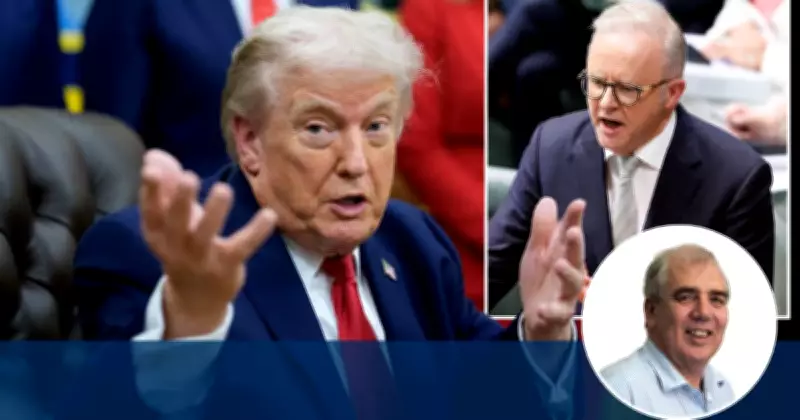
Global Realignment: Nations Forge New Paths Away from US Dominance
The Australian government's notably subdued reaction to the landmark trade agreement between India and the European Union speaks volumes about the shifting dynamics of international relations. This pivotal moment arrives as numerous nations actively pursue alternatives to the economic, military, and cultural frameworks historically dictated by the United States, particularly under the administration of President Donald Trump.
A Watershed Moment in International Trade
While negotiations for the EU-India trade pact spanned several years, its finalisation coincided with a critical juncture. Europe had just confronted President Trump over his controversial actions regarding Greenland and Canada, alongside his imposition of additional tariffs on European nations that supported Denmark. This context transformed the agreement into a symbol of resistance against unilateral American pressure.
The silence from Prime Minister Anthony Albanese and his cabinet ministers regarding this historical development is telling. It reflects a cautious, yet significant, undercurrent within Australian diplomacy—a potential alignment with a growing international movement determined to resist global bullying tactics. Trump's retreat on issues like Greenland and punitive tariffs, following unified European opposition and a compelling speech by Canadian Prime Minister Mark Carney at Davos, demonstrated that his bluster could be challenged.

The Emergence of a New Economic World Order
The retreat signalled a potential transformation. Carney's address outlined a vision for a new economic world order, one that could gradually replace the international institutions and rules established eighty years ago, which are no longer solely dominated by US economic power. This emerging system remains a work in progress, but it unequivocally opens the door for a global trading bloc that excludes the United States.
This does not inherently imply boycotts against the US. However, as Trump enforces high tariffs seemingly at random, producers and traders from other nations are increasingly motivated to seek alternative markets. Reducing dependence on the US market diminishes vulnerability to arbitrary coercion—whether driven by foreign policy objectives, attempts to impose specific social or political views on sovereign nations, or the flawed belief that American prosperity can be revived through protectionist walls.
Australia's Position in a Networked Trade Landscape
Australia finds itself well-positioned yet compelled to engage actively with this new reality. The EU-India deal alone promises to stimulate additional global production and trade. The European Union has already established similar agreements with Indonesia and other Southeast Asian nations, creating both new markets for EU goods and new sources of high-demand products for Europe.
Negotiations inevitably face hurdles, particularly concerning agricultural produce, as Australia's own dealings with Europe and India have shown. Yet, even agreements that do not eliminate all trade barriers represent a firm commitment to increasing trade, reducing obstacles, and establishing new legal frameworks for dispute resolution. These frameworks prioritise law and settled rules over ad hoc state interventions often unrelated to the actual goods or services being traded.
Australia already maintains trade agreements with India, most of Southeast Asia, China, Japan, South Korea, Canada, the US, and Britain. Protracted negotiations with the EU are likely to gain momentum from the India deal. While each bilateral agreement retains unique features, a broader trend toward open economies and multilateral pacts works to harmonise differences. Failure to collaborate risks diverting wealth to third-party arbitrageurs and smugglers.
Beyond Bilateral Deals: Toward a Multilateral Network
The true opportunity lies not in isolated bilateral deals but in an interconnected network of arrangements spanning much of the globe. When agreements follow a coherent pattern, they can evolve into multilateral pacts, accessible to other nations on similar terms. There is no inherent reason to exclude China from such frameworks. China's own efforts to diversify its markets, partly due to trade tensions with the US, align with this trend.

Australia and many of China's trading partners distinguish between defence partnerships with the US and Western allies, and economic partnerships with China as a crucial market for exports like minerals and a source of manufactured imports. Australia enjoys a substantial trade surplus with China, which would likely persist even if China deepened trade ties with the EU, Britain, and Canada. Reducing China's reliance on the US as a primary customer would also decrease its susceptibility to American coercion.
The Erosion of US Power and Prestige
The Trump era has significantly eroded American power, prestige, and global respect. While all nations prioritise their own interests, there is a growing international emphasis on consistency, decency, and respect for law and due process. The need for restraint and adherence to international norms has never been clearer. Nations, like citizens, are expected to be good members of the international community. Yet, Trump consistently disregards established rules, failing to promote fundamental human values or rights.
His approach has damaged the perception of the US among traditional allies like Australia, making it difficult to view Americans as "just like us." Domestically, his policies have been as contentious and lawless as his foreign maneuvers—defying courts, inciting violence, and implementing deportation policies with notable cruelty. His administration has been marked by racism, attacks on judges and former officials, and the misuse of public institutions for personal vendettas and cronyism.
A Path Forward for Australian Foreign Policy
This landscape presents Australia with a critical opportunity to chart a new course. The first step involves deepening economic unions based on free trade with nations in Europe and Asia—partners who refuse to be coerced by arbitrary tariffs or a US that often takes its allies for granted. Australia shares profound cultural, historical, and institutional commonalities with Western Europe and many regional neighbours.
While an immediate, dramatic rupture with the US may not be necessary or prudent, the divergence in shared values, interests, and visions of good international citizenship appears increasingly inevitable. As Australia and the United States continue on separate paths, this parting may ultimately benefit both nations, fostering a foreign policy for Australia that is more independent, principled, and aligned with a broader coalition of nations committed to a rules-based international order.