Foreign diplomats and embassies based in the national capital are collectively ignoring more than $63,000 in unpaid traffic fines, according to the latest government records. The data, which covers infringements issued over nearly three decades, shows a pattern of offences including speeding in school zones and illegal parking.
Decades of Unpaid Infringements Revealed
Government figures indicate that 66 fines issued to international officials in the Australian Capital Territory between 1996 and August 2025 remain outstanding. The total debt owed to the ACT's Chief Minister, Treasury and Economic Development Directorate has now surpassed the sixty-three thousand dollar mark.
More than half of this amount, a sum of $30,699, is attributed to individual diplomats from various countries who have not settled their penalties. A further 13 infringements, issued to smaller foreign missions with fewer than three staff in Canberra, add up to $8,915. The identities of these smaller missions have been withheld by the ACT government to protect their employees.

A spokesperson for the territory confirmed the dataset, last updated in October 2025, includes fines issued by both Access Canberra and ACT Policing.
Speeding and School Zone Offences Top the List
Analysis of the fines shows that speeding was the most common traffic offence, accounting for 46 per cent of all unpaid infringements. Alarmingly, five of these fines were for speeding by 15km/h or less within ACT school zones.
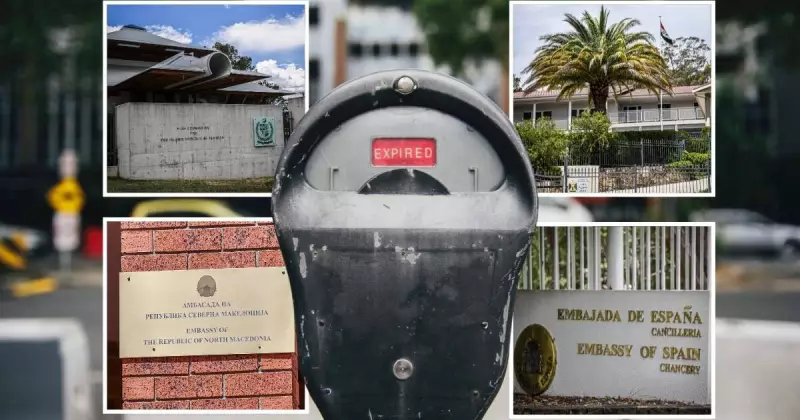
Specific cases highlight the issue. The Nepali embassy has an outstanding fine of $1,609 after one of its vehicles was caught speeding in a school zone in July 2025. Similarly, the Embassy of North Macedonia (listed as the 'former Yugoslav Republic of Macedonia') owes $1,424 for a speeding violation in a non-school zone from September 2024.
Other major offences include:
- Red-light camera infringements, making up 30 per cent of unpaid fines.
- Mobile phone use while driving, captured by traffic cameras and accounting for 24 per cent of offences.
- Parking violations, including fines issued to the Embassy of China for parking on nature strips and to the Embassy of Saudi Arabia for parking in areas reserved for disabled people.
Embassies with Long-Standing Debts
Public records reveal some fines have been ignored for an extraordinarily long time. The Embassy of Spain, for instance, has an outstanding parking ticket from December 1996. The $67 fine was issued for parking next to an expired meter, a type of infrastructure that was phased out in Canberra two decades later.
Other missions with recent outstanding fines include:
- The Embassy of the Republic of Iraq, which owes nearly $3,000 for two speeding fines from 2024 and 2025, one in a school zone.
- The High Commission of Nigeria, which owes about $720 for a speeding fine in a non-school zone.
- An individual foreign diplomat and the High Commission of Pakistan, who share the record for the highest single outstanding fine at $2,534 for mobile phone offences detected in mid-2025.
No Immunity from Road Rules
Contrary to popular belief, diplomatic immunity does not provide a blanket exemption from traffic laws in Australia. A territory spokeswoman stressed that the process for an embassy or diplomat to pay a fine is the same as for any other motorist.
"Diplomatic and consular staff are expected to familiarise themselves with and abide by Australia's road rules and pay all traffic and parking infringements promptly, unless they intend to contest the infringement," the spokeswoman said.
Access Canberra works with the Department of Foreign Affairs and Trade (DFAT) to follow up on outstanding fines, but DFAT's policy is clear: it cannot intervene to seek a waiver or cancellation. The department's website explicitly states that driving a motor vehicle is considered outside the scope of consular functions, meaning immunity does not apply to traffic offences.
Furthermore, ACT Policing retains the authority to stop any vehicle, including those driven by diplomatic agents, for alcohol or drug screening tests. Dependants and administrative staff of consular officials have even less protection and can be arrested or detained for offences.

The accumulating debt highlights an ongoing challenge for Canberra authorities in enforcing local laws within the unique diplomatic community of the national capital.