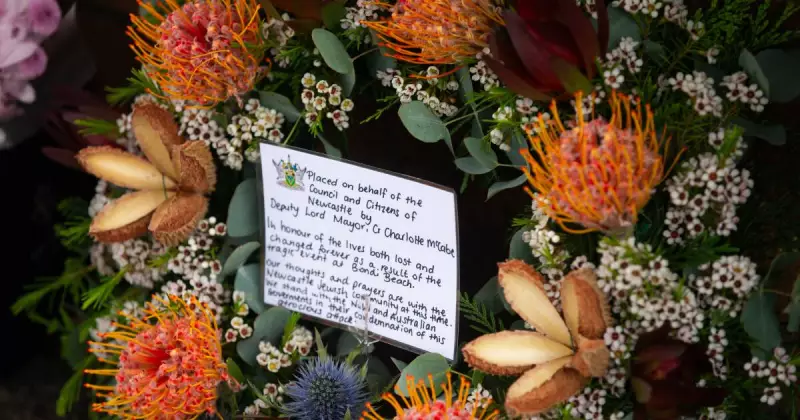
Australia is in mourning, with tributes piling up outside synagogues nationwide following Sunday's horrific mass shooting at Bondi Beach. The attack, the worst of its kind since Port Arthur in 1996, has plunged the nation into grief and ignited a fierce debate about security, prejudice, and political leadership.
Security Failures and Disturbing Revelations
As investigations continue, disturbing details about the two perpetrators have surfaced, raising serious questions for governments, police, and security agencies. On Tuesday, it was revealed that one of the terrorists had his gun licence issued after his son was questioned by ASIO back in 2019. The pair had also recently travelled to the Philippines, a known hotspot for Islamic extremism.
Police confirmed the men displayed an Islamic State flag in the vehicle used to reach the murder scene. While a full probe will take months, early scrutiny suggests the police presence at a well-publicised Hanukkah community event was insufficient. This is no criticism of the frontline officers, who confronted heavily armed terrorists with pistols and immense bravery, but it prompts urgent questions about risk management and resource allocation.

A National Focus Misses the Core Issue
Monday's national cabinet meeting appeared narrowly focused on gun control. While reforms are undeniably urgent—highlighted by the absurd lack of a national gun register 29 years after Port Arthur—fixating solely on firearms risks obscuring the toxic prejudice at the heart of this tragedy: anti-Semitism.
For many in the Jewish community and beyond, this massacre is seen as the catastrophic endpoint of a rising cascade of hate. Chants of "where's the Jews?" were heard at the Sydney Opera House just days after the October 7, 2023, attacks in Israel. That moment should have been a national wake-up call. Within pro-Palestinian movements, fringe elements have publicly supported Hamas in ways indistinguishable from anti-Semitism. Synagogues have been firebombed, businesses vandalised, and Jewish students have felt unsafe wearing their uniforms in public.
Warnings from the Jewish community about this creeping threat have been consistent. Yet, the federal government's response has been widely perceived as weak and inconsistent. For two years, Labor frontbenchers have often coupled any mention of anti-Semitism with immediate references to Islamophobia, failing to confront the specific menace at hand with decisive clarity.
A Defining Test for Albanese's Leadership
Prime Minister Anthony Albanese holds a position of significant political power, but the coming days and weeks will likely define his legacy. He faces a test similar to that which confronted John Howard after Port Arthur. Thus far, his response has not convincingly met the moment, falling short of the standard set by NSW Premier Chris Minns in both words and actions.
Amid the necessary political scrutiny, the extraordinary courage of ordinary Australians on that terrible Sunday stands in stark contrast. A shopkeeper wrestled a rifle from a terrorist while being shot multiple times. A mother used her body to shield another woman's child. A husband died protecting his wife. On Tuesday, it was revealed an elderly couple disarmed one gunman before the worst of the killing, paying for their bravery with their lives.
Courage was abundant on Bondi Beach. Now, that same quality is desperately needed in the political arena to address the security lapses and, more profoundly, to combat the ancient, resurgent hatred of anti-Semitism that fuelled this national tragedy.