There are tears in the eyes of my guide Keiko when I pause to photograph a stone carving depicting Maeda Matsu, wife of Maeda Toshiie, whose family dynasty ruled the Japanese city of Kanazawa for almost three centuries.
“She sounds like an extraordinary woman. I wish I’d been able to meet her.” I’m only thinking out loud, but Keiko appears overwhelmed that a visitor would recognise Maeda Matsu was key to her husband’s success, at a time when Japanese women very much were not recognised.
Maeda Toshiie was a forward-thinker who valued his wife’s opinion as much as his own. Their shared good sense and savvy go a long way to explaining how Kanazawa has grown and thrived to become Japan’s city of quiet luxury.

To understand any Japanese city, you need to know a little of its history. Some countries are profoundly influenced by their ancient past, while others are reshaped entirely by colonisation. Neither applies to Japan, which was long shielded from outside influences and was never conquered.
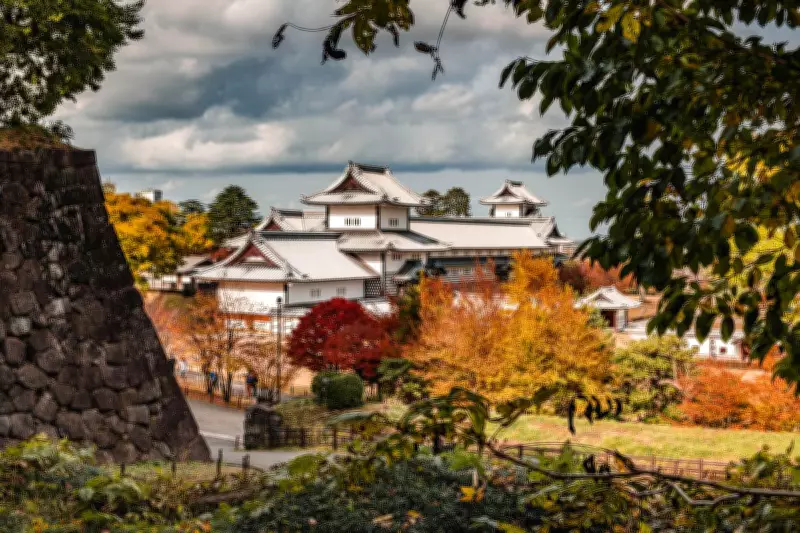
“The Maeda clan’s success was built on soft power,” Keiko explains as we stroll through the city’s Kenrokuen Garden, widely considered Japan’s finest. “From the day Maeda Toshiie occupied what would become Kanazawa Castle in 1583, he knew he would need to keep the ruling shogun in Tokyo onside. So, he very publicly prioritised the arts over military ambition.”
Artisans and crafters of all stripes continue to gravitate to Kanazawa (population 465,000). In every neighbourhood, there are workshops dedicated to ceramics and lacquer-work, art and design, or to the gold leaf decorating for which the city is famous.
Kanazawa was designated a UNESCO Creative City in the field of crafts and folk art in 2009, which helps me not at all right now as, with razor-sharp box cutter in hand, I do my best to follow Japanese instructions on how to cut out my chosen design then apply a micro-thin layer of gold leaf to decorate my black lacquered bowl.
It turns out that more rewarding than shopping for a souvenir in Kanazawa is to make your own. Incredibly, Kanazawa produces 99 per cent of Japan’s gold leaf (Entsuke, in Japanese), formally recognised by UNESCO in 2020 as a practice of “intangible cultural heritage”.
Besides championing the arts, Maeda Toshiie had another card to play. He required all samurai families to live clustered together near the castle, thereby creating a deterrent to any would-be attackers. The samurai were Japan’s highest caste, but also its warriors — skilled in fighting with katana (sword), spear, bow and arrow, and proficient in the martial arts. Because Kanazawa was not bombed during World War II, the city remains one of very few to have an intact samurai precinct.
Keiko has joined me for a visit to the discreetly glamorous Nomura Clan Samurai House. Here, I pause to study a suit of real samurai armour, which reflects the old-world arms race that existed everywhere — an improvement in armour would, in turn, spark a redesign of the sword intended to penetrate it.
No sword made by human hand has rivalled the lethality and elegance of the katana. For centuries in Japan, only the samurai were permitted to carry weapons — a fact which has added to the katana’s enduring mystique.
All this is swirling in my mind as I sit in silent contemplation overlooking the Nomura family’s sculpted, peaceful garden — what exactly happened to the samurai?
These matchless warriors, who had fended off rival Japanese warlords and multiple invading foreign armies, were to be replaced by the newly reinstated imperial regime’s conscripted national army. It was a sudden transition, too: imperial rule restored in 1868; new army established by 1873; samurai stripped of social privileges in 1876, and their right to bear arms rescinded. The emperor had decided to turn these men into administrators and bureaucrats — warriors who would become worriers.

Thousands of samurai mounted an insurgence, and what became known as the 1877 Satsuma Rebellion (named for the province in far south-western Japan where many disaffected samurai had gathered), cost the empire dearly in money and men. Saigo Takamori, portrayed in books and films as the last true samurai, was their reluctant leader. Up to and including the Hollywood film The Last Samurai (2003), he represents a noble warrior’s stand against the relentless march of modernity.
A garden was, for any samurai, indispensable as a place for quiet reflection, and likewise I find myself strolling towards Kenrokuen Garden each evening of the week I’m in Kanazawa. But every day I never quite get there, although the garden is 400m from where I fetch up. Here, by the Shinto Oyama Shrine, with its more modest Gyokusen-en Garden, is a life-size statue of samurai Maeda Toshiie on horseback, katana sheathed, spear in hand.
Toshiie died in 1599, amid the tumultuous period which would lead to the establishment of Tokugawa Shogunate, Japan’s last. The Maeda clan had prospered as the country’s leading artisans moved to Kanazawa, but meanwhile, the Shogun had become wary of its power and wealth. Maeda Matsu assessed the threat, and immediately after her husband’s death, in 1600 volunteered herself hostage to the Shogun, living for 14 long years in Tokyo, before returning to Kanazawa. Her sacrifice had ensured the Maedas’ survival, and they would go on to dominate life in Kanazawa right up until imperial reformation in 1868.
Maeda Toshiie cuts a mighty figure here, his bronze statue fittingly just a few metres away from that of his beloved wife. Not much about this kneeling, demur figure carved in stone gives away just how formidable Maeda Matsu was, or how large a shadow she casts over Kanazawa’s fortunes to this day.
Cameron Wilson was a guest of Visit Kanazawa. They have not influenced this story, or read it before publication.
Fact File
- Plan a trip to Kanazawa with the help of visitkanazawa.jp/en/
- To get to Kanazawa from Perth by air, fly to Tokyo then transfer to Komatsu Airport, the nearest airport to Kanazawa.
- To get to Kanazawa by rail from Tokyo, take the direct, high-speed Hokuriku Shinkansen, which takes less than three hours. Travel time is similar by train from Osaka (about 2½ hours).