I have been thoroughly enjoying Jiawa Liu's stylish and picture-packed new guide to the French capital, 7 Days A Parisian (Murdoch Books, $45). And the word “feasting” is particularly apt: Liu, a Chinese-born resident of Paris who was raised in Australia, offers fascinating insights into French cuisine, both in her book and during our interview.
For instance, in France, a loaf of bread is always placed directly on the table rather than on a plate, and never with the flat side facing up. Liu explains that this tradition dates back to medieval times, when bakers would mark the executioner's loaf by placing it upside down. “It’s the kind of detail that says everything about how history, habit, and daily life overlap in Paris,” she tells me.
After working as a lawyer for seven years, Liu made the “impulsive decision” to move to Paris in 2016 without any concrete plans. She has remained there ever since, flaneuring—rather than sashaying—through the city in what she describes as a “perpetual state of wonder,” while building a career as a creative director, contributing editor to Vogue Australia and Harper’s Bazaar Singapore, and founder of the luxury creative agency Beige Pill.

Vogue has called Liu the “master of living, dressing and thinking simply.” Her book, structured around seven day-long itineraries, distills a decade of living and working in Paris. Yet, as she notes, her legal mind has never truly switched off, even after hanging up her wig and gown for good.
“There’s an almost compulsive need to understand why things are the way they are: why are the neighbourhoods arranged the way they are?” she says. “Why do Parisian house parties inevitably dissolve into 80s karaoke, when most guests are far too young for it to be genuinely nostalgic?”
This drive led to two years of deep research, resulting in a book that, despite its aesthetic appeal, is fundamentally “an attempt to understand Paris itself.” In Liu’s view, a Parisian itinerary should never be merely a checklist. The book’s seven itineraries range from the cinematic to the secluded, from the bewildered to the calm. Day one covers icons like the Louvre, while day seven delves into life as lived by locals.
When pressed to choose the day that best captures the soul of Paris, she selects day four: quieter, less monumental, and centred on the inner neighbourhoods of the Left Bank. For those seeking a full movie-set experience, day two offers cinematic Paris, focused on Montmartre.
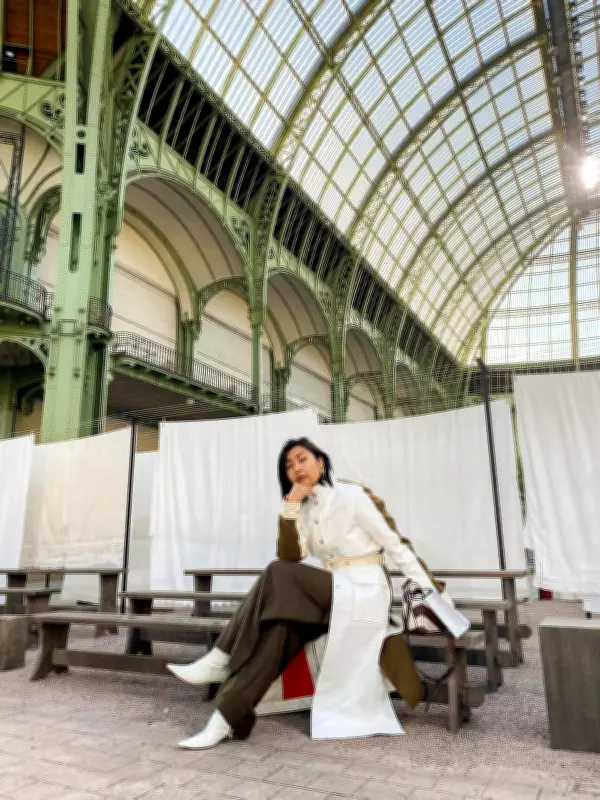
I am keen to hear Liu’s thoughts on French clichés. She admits to a genuine affection for them, partly because many are true. However, she agrees there is a tale of two Parises: the Paris of the Grand Palais and the Palais de Chaillot, which her fashion career has opened up to her, and the invisible Paris of antiquated neighbourhood restaurants with no English menus.
“Most Parisians live almost oblivious to the monuments surrounding them,” she says. “There are people born and raised in this city who have never been to the top of the Eiffel Tower.”
For those who believe they have already “done” Paris, Liu offers further advice: “Don’t plan, just wander deeper into the neighbourhoods, and leave yourself open.” I couldn’t agree more.