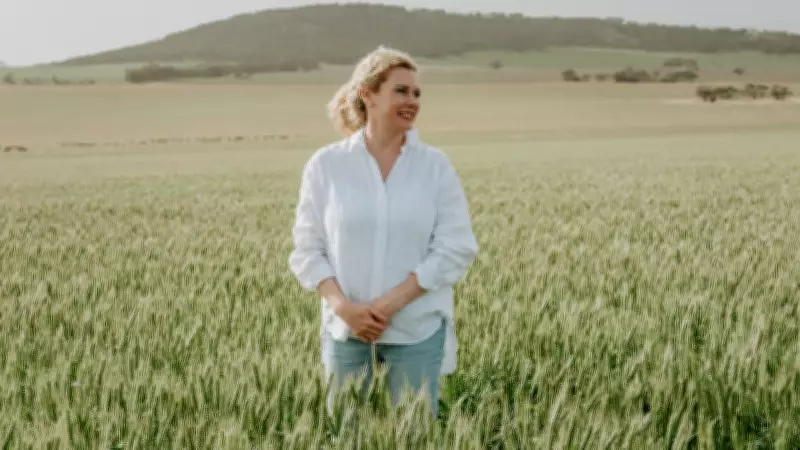
A farm girl turned professor discovered the impossible paradox: Australia's most capable problem-solvers need help with problems they cannot solve.
Bridging the gap
In rural communities, a farmer's resilience is often worn as a badge of honour, and asking for help can be one of the hardest things to do. For Associate Professor Kate Gunn, bridging the gap between need and support for our primary industries has become the focus of her life's work.
Drawing on both her upbringing on a farm near Streaky Bay and her career as a psychologist and researcher, Professor Gunn has spent years reshaping how mental health is understood and delivered in farming communities. She has found that traditional approaches to mental health support often fail to connect with rural Australians. Services designed in urban spaces can miss the mark in communities where stoicism, independence, and true grit run deep. Farmers, she explains, are highly capable problem-solvers – but many of the pressures they face are beyond their control.

"If there's a problem to fix, they'll fix it," she says. "But so many stressors are outside their control. Over the years I developed a strong sense that many people in the city didn't really understand those things, and I could see the challenges being faced by people at home."
Those stressors – drought, rising costs, and unpredictable conditions – are not just economic challenges; they have profound mental health consequences. Farmers experience suicide rates twice that of the general working population, a reality that continues to drive Professor Gunn's work.
"The ripple effect of suicide in a rural community is enormous," she says. "Being able to translate research into practical ways to help people on the ground is what keeps me going."
Meeting farmers where they are
Professor Gunn has focused on meeting farmers where they are – both physically and culturally. That has meant moving beyond clinics and into everyday spaces like farming conferences, community gatherings, and even pubs.
"I'd go to a party or go to the pub, and after people had a bit of Dutch courage, they'd come up to me and say, 'I'm really worried about this person – what do you think we should do?'" she says. "At times I felt a little helpless because there weren't really mental health resources I could point people to that were culturally appropriate and would resonate with members of the farming community."
Experiences like this led to initiatives such as the iFarmwell website, which offers practical tools that actually work for farmers, as well as broader campaigns such as Weather It Together. The campaign breaks it down into four straightforward actions – stay connected, focus on what you can control, keep active, and ask for help.
Unconventional delivery methods
For Professor Gunn and her team, research has shown that how the message is delivered is just as important as the message itself. To reach audiences who may not actively seek support, they have turned to unconventional methods – podcasts, social media, and even live performances. In one initiative, real-world mental health tips were woven into a musical performed in regional towns, offering a lighthearted gateway to start difficult conversations.
"We find that farmers listen to other farmers more than they listen to experts," Professor Gunn explains. "So we capitalise on that … a lot of it is featuring other farmers sharing their lived experiences of what they've done to help themselves. It's about using language and examples they can actually relate to."
At the end of the day, it's not about chasing academic results – it's about making a real difference on the ground. She sees research as a way to understand rural communities better and to build systems that actually work for them.
"My goal is to make sure people in rural areas can get the support they need, in ways that actually fit their lives," she says. "It's about building on what's already working and helping communities thrive, not just ticking boxes."
"It's a wicked problem," she says. "But we are chipping away at it, one practical solution at a time."

In her words
As an Enterprise Fellow in Rural Health and Co-Director of the IIMPACT in Health research concentration at Adelaide University, I lead a team working across psychology, behavioural science and public health, focusing on areas including farmers' mental health, suicide prevention and improving rural cancer outcomes.
I bring to the role experience from growing up on a farm near Streaky Bay, and working as a clinical psychologist. This means my passion for ensuring people in rural communities have access to health and mental health support that meets their needs, is both personal and professional.
Too often, solutions are designed with an urban mindset, and they don't always translate. Rural communities have incredible strengths, and we need to recognise and work with those, while still addressing the unique challenges they face.
Improving wellbeing and reducing suicide in farming communities is a big part of my motivation and is why I founded ifarmwell in 2018. It's a privilege to be able to work with rural people to help convey their health and mental health-related needs, and develop and test strategies to address them, via our research. I'm really grateful to the funders and industry partners who make this possible, and I am proud to be able to use my work to help people living in the types of rural communities, in which I grew up.