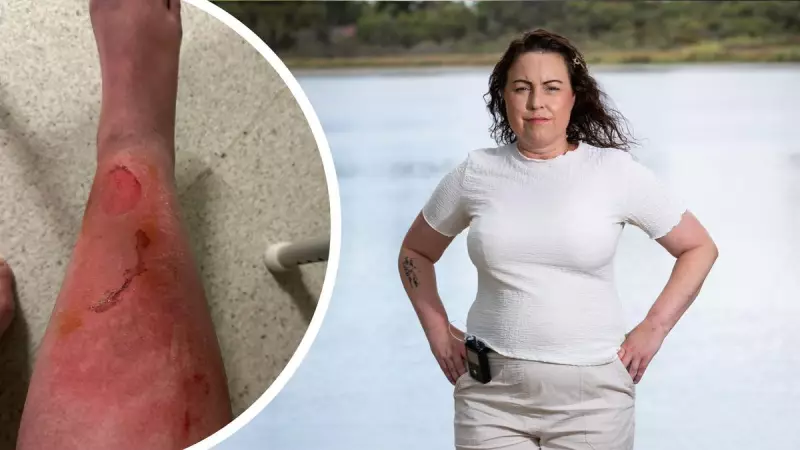
A Perth mother has issued a stark warning to beachgoers after a seemingly minor jellyfish sting during a family holiday escalated into a life-threatening infection that nearly cost her a leg.
A Christmas Holiday Turned Nightmare
Andrea Bowden was enjoying the shallows of Peppermint Grove Beach near Capel, south of Busselton, with her daughter when she felt a sudden, intense burning sensation across both legs. Despite exiting the water, she saw no visible cause. Determined not to ruin the family's Christmas celebrations, she initially tried to shrug off the increasing pain.
"It just kept getting worse, the leg was swelling and the foot started to go black so my husband called the ambulance," Ms Bowden recalled. What followed was a harrowing medical ordeal that saw her admitted to Fiona Stanley Hospital with a severe case of sepsis originating from the wound.

The Fight to Save a Limb
At the hospital, the situation became dire. Medical staff discussed the possibility of a below-the-knee amputation if they could not control the rapidly spreading infection. "There was talk of, if this leg goes bad, then it has to come off . . . potentially a below the knee amputation," Ms Bowden said.
Dr Ashley Fox, an emergency consultant at Fiona Stanley Hospital, explained the gravity of the situation. "We need to be really mindful of infection developing in the bone," he said. The medical team even considered using medical maggots to debride the necrotic tissue from the ravaged limb, a method known for its precision in removing dead skin.
Fortunately, early and aggressive intervention with antibiotics, combined with surgical debridement where Dr Fox removed non-viable skin, prevented the worst outcome. "If I’d been in any other country in the world I think I wouldn’t be here today. I’m just really lucky," a grateful Ms Bowden stated, adding she even bought a Lotto ticket in the wake of her recovery.
A Warning to Other Swimmers
The culprit was identified as a Carybdea xaymacana jellyfish, a species found in non-tropical waters like those of WA's south-west. Unlike the deadly Irukandji of the state's north, this species is not typically life-threatening, but its sting can range from mild to severe.
Capel Shire President John Fergusson noted these jellyfish, which measure around 3 centimetres, have only recently started appearing in numbers at Peppermint Grove Beach. He advised beach users to wear protective clothing and avoid swimming where large numbers are present.
For Ms Bowden, who is a type-one diabetic, the sting created "the perfect storm" for a severe reaction. She has now stocked up on vinegar, a common first-aid treatment, but Dr Fox recommends a different approach: washing the area with saltwater followed by hot water to remove remaining sting cells. Most importantly, he urges people not to ignore persistent pain.
Ms Bowden's message is clear. "I am never going in the water without longs, ever," she vowed. "And just don't leave it. You think to yourself it’s just a sting, but it can turn pretty nasty pretty quick."