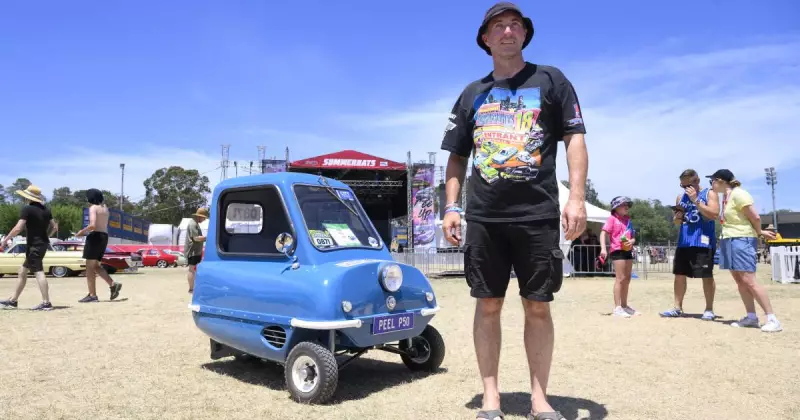
In a spectacular twist at the heart of Australia's most muscular automotive celebration, the loudest cheers were reserved for the quietest and smallest contender. The Summernats 2026 festival in Canberra, traditionally a deafening arena of V8 engines and burning rubber, found an unlikely hero in a vehicle barely larger than a shopping cart.
The Unlikely Crowd Favourite
As the opening parade of 500 vehicles rumbled to a close on January 10, 2026, the star that emerged wasn't a thundering hot rod but a gentle chug. Adam Povey from Cooma piloted his Peel P50, a three-wheeled microcar, past the crowds to rapturous applause. The tiny fibreglass machine, struggling to reach 40km/h with its 50cc engine, instantly became a sensation on the showground, drawing constant crowds of fascinated onlookers.
"I haven't had any negative feedback," said Mr Povey, a self-confessed car enthusiast who has entered other vehicles in Summernats before but has now made the Peel P50 his signature exhibit. This marked his second year showcasing the unique vehicle at the festival.

A Seven-Year Quest for the Smallest
The journey to the Summernats spotlight began about seven years ago when Adam Povey set himself a unique mission: to acquire and rebuild the world's smallest mass-produced car. His search led him to the Peel P50, officially recognised by the Guinness Book of World Records as the smallest road-legal car ever made.
Originally manufactured between 1962 and 1965 by the Peel Engineering Company on the Isle of Man, the car was designed as an urban runabout. The company, known for fibreglass boats, envisioned a vehicle for a driver and a single shopping bag. Povey tracked down an original model to Britain and embarked on a global hunt for spare parts, fabricating some components himself.
Charmingly Impractical and Road-Legal
The car's charming quirks are a major part of its appeal. It lacks a reverse gear, meaning Povey must physically pick up the rear to turn it around. With a top speed of around 40-50km/h, it's not built for highways. "It's all over the place," Povey admitted, offering an apology to any motorists he might hold up. He emphasises he has no desire to go faster, noting a collision in the lightweight fibreglass body would be disastrous.
Despite its size, the Peel P50 is fully registered for Australian roads, a feat that involved a bureaucratic battle. The vehicle initially lacked a Vehicle Identification Number (VIN), requiring one to be officially issued before it could be imported.
While Povey's model is an original, the Peel company has resumed production with modern updates, including a reverse gear. New models offer either a 49cc petrol engine or an electric motor, with a top speed of 45km/h.
The triumph of the tiny Peel P50 at Summernats 2026 proves that in a world dominated by horsepower and noise, ingenuity, history, and sheer audacity can still win the hearts of a crowd.