Lost WA Fossil Rediscovered After 50 Years Reveals Ancient Marine Predator Duo
In a remarkable twist of scientific fate, the remains of an ancient marine amphibian from Western Australia, first lost to time and then to a museum bungle, have been rediscovered after five decades, leading to a groundbreaking new discovery. This fossil, once thought to represent a single species, has now been identified as two distinct creatures, offering fresh insights into prehistoric ocean ecosystems.
A Journey Through Time and Misplacement
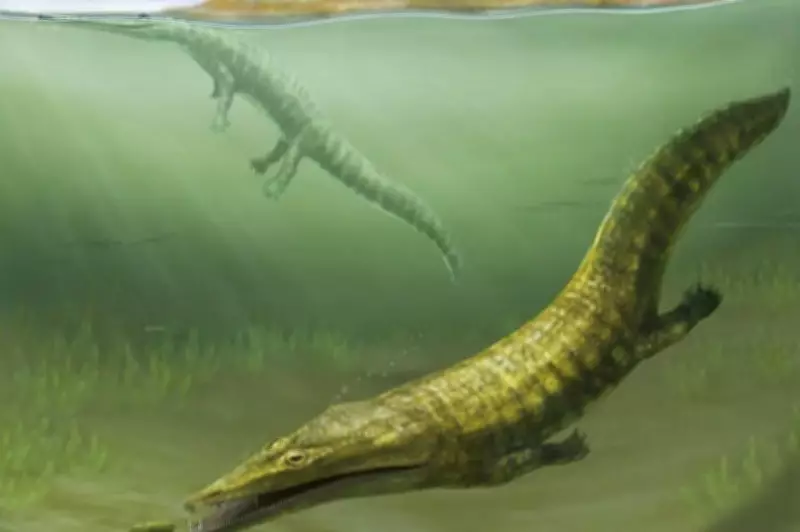
Dating back 252 million years to the Mesozoic era, when dinosaurs began their reign, what is now the arid Kimberley region of WA was once the shoreline of a shallow bay bordering a vast prehistoric ocean. This period marked the emergence of modern marine systems following the catastrophic mass extinction at the end of the Permian, giving rise to early sea-going limbed vertebrates known as tetrapods, which became the dominant predators of the seas.
In 1972, a significant paper described several tetrapod skull fragments found weathering out of a rocky outcrop on Noonkanbah cattle station east of Derby. Researchers named the new species Erythrobatrachus noonkanbahensis and distributed the specimens between museum collections in Australia and the United States. However, over the ensuing years, these valuable fossils were lost, sparking an international search effort.

The Rediscovery and Surprising Revelation
The search culminated in 2024 when it was discovered that one of the Noonkanbah fragments had been mislabelled and was gathering dust in a vault at Berkeley in California. Now, a collaborative team from the University of New England, WA Museum Boola Bardip, Curtin University, and the University of New South Wales has made a second remarkable find.
Erythrobatrachus was identified as a trematosaurid temnospondyl, a crocodile-like relative of modern salamanders and frogs that could grow up to 2 meters in length. However, when the team examined the lost fossil fragment from Berkeley and compared it to a high-quality plaster cast of another fragment, they uncovered something unexpected.
High-resolution 3D imaging of both specimens revealed not one, but two species of trematosaurid: Erythrobatrachus and another species attributable to the well-known genus Aphaneramma. These findings were recently published in the Journal of Vertebrate Paleontology, highlighting the significance of the discovery.
Implications for Prehistoric Ocean Life
While Erythrobatrachus has only been found in Australia, fossils of Aphaneramma have been reported from diverse locations including the Scandinavian Arctic, the Russian Far East, Pakistan, and Madagascar. The new analysis of the Noonkanbah fragments suggests that these earliest Mesozoic marine tetrapods were much more widespread in prehistoric oceans than previously believed.
This discovery not only corrects a long-standing error but also enriches our understanding of ancient marine biodiversity. The rediscovered fossils of Erythrobatrachus are now being repatriated to Australia, ensuring they are preserved for future research and public education.
In summary, this story underscores the importance of meticulous museum curation and international collaboration in paleontology. It reveals how a simple mislabelling can lead to decades of obscurity, yet also pave the way for exciting new scientific insights into Earth's distant past.