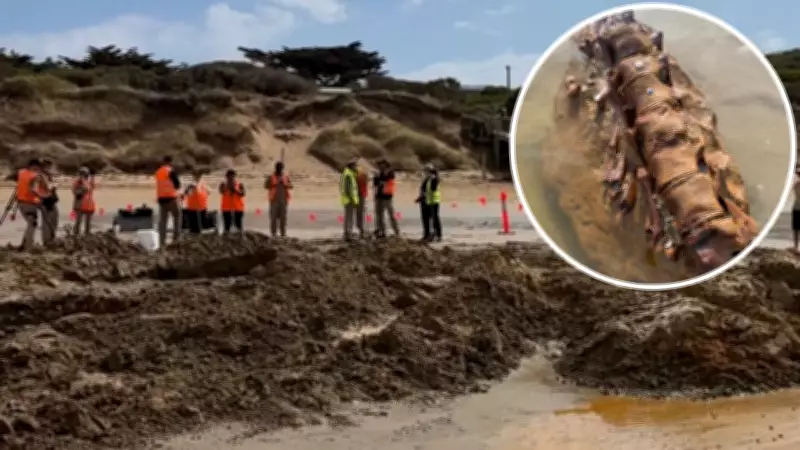
Rare 20-Million-Year-Old Whale Fossil Unearthed at Ocean Grove Beach by Museums Victoria
In a remarkable paleontological discovery, Museums Victoria has excavated a stunning 20-million-year-old whale fossil from Ocean Grove Beach, located along the picturesque Victorian coastline. This significant find promises to shed new light on the ancient marine ecosystems that once thrived in this region, providing invaluable data for researchers and scientists dedicated to understanding the evolutionary history of whales.
Discovery Details and Excavation Process
The fossil was uncovered during a routine survey conducted by a team of expert paleontologists from Museums Victoria, who were meticulously scanning the beach area for signs of prehistoric life. Upon identifying the fossilized remains, the team initiated a careful and systematic excavation to ensure the preservation of this delicate specimen. The process involved precise digging techniques and the use of specialized tools to extract the fossil without causing any damage, highlighting the meticulous approach required in such paleontological endeavors.
Scientific Significance and Research Implications
This 20-million-year-old whale fossil is not just a rare artifact; it represents a crucial piece of the puzzle in marine biology and evolutionary studies. Scientists believe that the fossil could belong to an extinct species of whale, offering insights into the anatomical features, behaviors, and environmental adaptations of these ancient marine mammals. By analyzing the fossil, researchers aim to reconstruct the prehistoric marine habitats of Victoria, contributing to broader knowledge about climate changes and biodiversity over millions of years.

- Its potential to reveal new information about whale evolution during the Miocene epoch.
- Opportunities to study the fossil's preservation state, which may indicate past environmental conditions.
- Enhanced understanding of how marine life in the region has transformed over geological time scales.
Community and Educational Impact
The discovery has generated excitement not only within the scientific community but also among local residents and visitors to Ocean Grove Beach. Museums Victoria plans to incorporate the fossil into their educational programs and public exhibitions, allowing people to engage with this piece of natural history firsthand. This initiative aims to foster a greater appreciation for paleontology and environmental conservation, inspiring future generations to explore and protect Australia's rich fossil heritage.